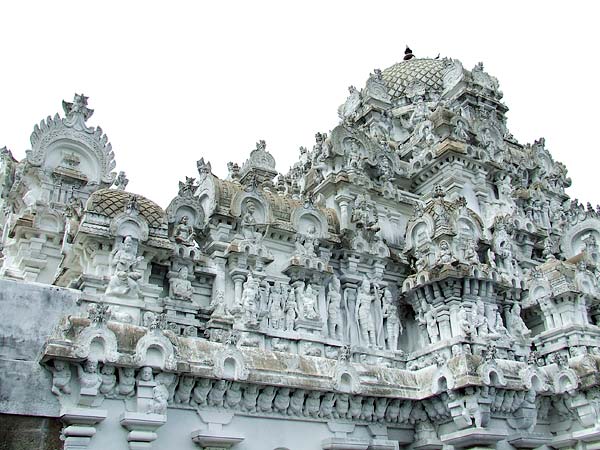
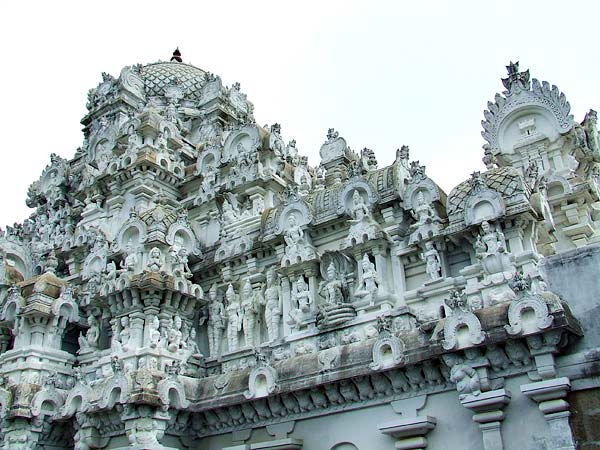
Showing posts with label tamilnadu kovil. Show all posts

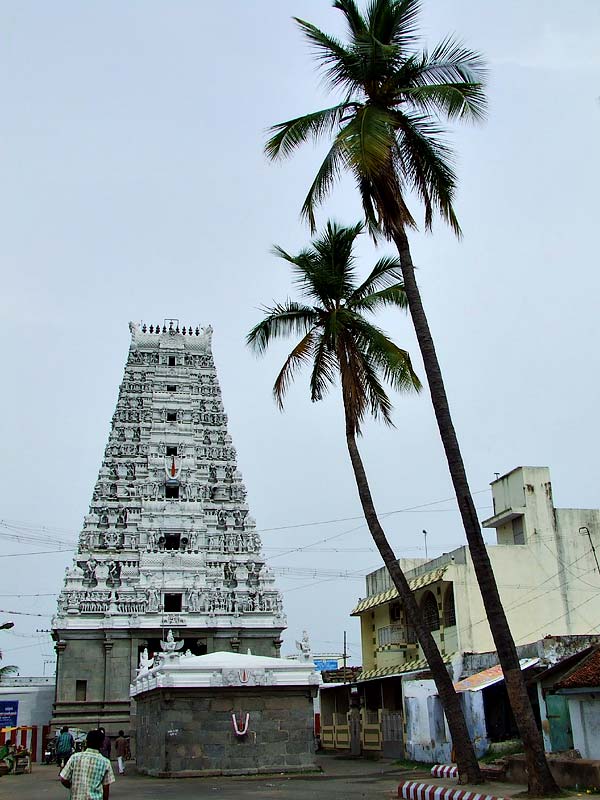
Sri Karpaga Vinayagar Temple - Pillayarpatti

Pillayarpatti is located at Sivaganga district in Tamil Nadu state. It is next to it is on the way  to Tirupattur kunrakkuti from Karaikudi. Today the town is pillaiyarpatti known for all peopl but it was previously called as , 1. Ekkattur erukattur or, 2. Marutankuti, 3. Tiruvinkaikuti, 4. Tiruvinkaicvaram, 5. Iracanarayanapuram that has five other names. Marutankur, tenmarutur, kanecapuram, kanecamanakara. such names are found in the later inscriptions.

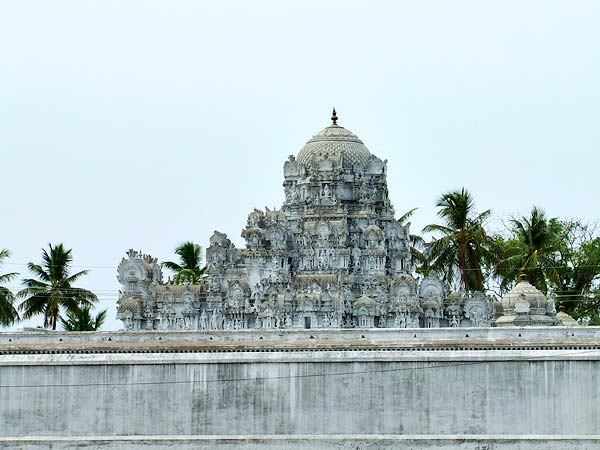
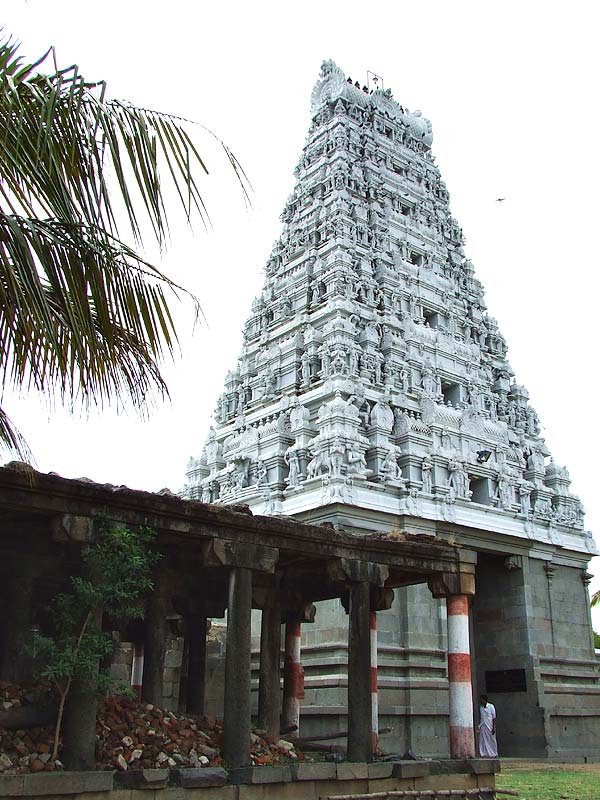
This is a large temple with two raja gopuram. And it seems tiruppani has been occurred four times in this temple.

As this is kutaivarai temple (Rock cut temple) we ran the first part of temple. And between the four pillars of the hall is a double hall. In the bottom of the hill on the forehead towards facing the 6 feet tall Ganesha karpaka vinayagar is located..  In the south west towards the forehead Sankara narayana and Garuda is seen on two sides...

Slightly west of north and south from there on north side can be seen  "linkothpavar murti." This is the largest kutaivarai temple for vinayakar (God of Wisdom) and this ancient temple built was built by Mahendra Pallava in 1600 A.D. This temple iis currently owned by Nakarattar (Trust).

Lord Ganesh is called as Man of wisdom. When you notice his face keenly, you could see the  "Om" sign…

Something Special about “Karpaga Vinayagar - Pillayarpatti”:

1. Karpaka Vinayakar or Desi Vinayaka Pillaiyar is the presiding deity here, and he is portrayed with two arms and a trunk curled towards his right in the valampuri mode.

2. This 6 feet tall mammoth image of Ganesha is a bas relief in an excavated cave.

3. Unlike other places the three Lingams Thiruveesar, Marudheesar and Senchadeswarar and the three Goddess Sivagami amman, Vadamalar Mangaiamman and Soundara Nayaga amman all appear together at the same place and bless the devotees.

4.Pillaiyarpatti Pillaiyar is having only 2 hands which is a special feature.

5.From the history of divine architecture and from stone sculptures and from the available documentary evidence Pillaiyarpatti Pillaiyar figure alone is the first Pillaiyar in the world.
Festivals:

This is one of the temple which follows the festivals in grand manner and The great and grand of festivals is Ganesh Chaturti in the month of Aug - September, where a ten day celebration makes much devotees to this temple town. Each day's celebration is marked by much splendor as Pillayar is taken in procession around town on several of his mounts, as are the other Pancha Murthys.

The ninth day of the festival is slated by a chariot procession. In addition, the ten day festival in the month of Vaikasi (May - June) is held in honor of Kongu Nachiyamman, a village deity whose processional image is also housed here. The Margazhi Tiruvadirai festival is celebrated in honor of Nataraja and Sivakami (Dec - Jan).

Temple Timing :

Every day, five worship services are offered to the presiding deity and temple will open at 6 AM , and close down at 9 PM. During the fourth phase of each lunar half month, Pillayar is taken in procession around the temple. Hundreds of pilgrims patronize the temple on these days.

Contact Info :

P.K.NK.TRUST
Pillaiyarpatti,
Sivagangai District
Tamil Nadu State

Phones: 04577-264240, 264241

e-mail  : pknktrust@yahoo.com, pknk.trust@yahoo.co.in


sholingar- Lakshmi Narasimha Perumal

This divya desam, also known as Sholingar, is situated in Madras-Bangalore Rail line. Easy way is to take brindaavan from Madras to Arakonam Junction and take Bus from there. Sholingar Railway station is 9 miles from the temple. One can take a direct bus from Madras as well. It has some moderate facilities including a big Kalyana Mandapam for organized group tours, a chattram for over night stay and several "Mess" facilities. This divya desam is also known as kadikaachalam.

It is believed that if one stays at this kshethram for atleast one kadigai (about half an hour), that person is gaurenteed mokshama. This is the only divya desam dedicated to Sri Narasimhar in Tamil Nadu. This divya desam is visited by many seeking His blessigns. He is teacher to His bhaktas who seek the removal of ignorance and a doctor to those who seek cure for various health problems.


Sri Amirtha Valli thaayaar

Sri Yoga Narasimhar


Sri vishnu purraanam and paathma puraanam offers details about this sthalam. It is believed that Sri Lakshmi Narasimhar came to this palce after hiranya vatham and stayed here for ever in this Yoga sayanam posture. It is well kown that Srinarasimha avathaaram took place at Sri Ahobilam. However, since munivars requested the presence of Sri Narasimha here on an endless timescale, The Lord Narasimha chose to stay here for ever. This is also confirmed by thirumangai aazhwaar's reference to thakkkaanai in his paasuram presented in this article. Among all the other avathaarams this and the vaamana avathaaram are the most significant becuase of the fact that they both accomplished the misssion instantly. Many of the LAkshmi Narasimha bakthaas believe that by praying to this Lord (who is an instant acccomplisher), their prayers are fulfilled instantly if not atleast an instant relief is offered without delay by this Lord.

It is a belief that, One, would attain Moksham simply by staying here for one Kadigai (period of time) ie approximately half hour in this shekthram. Hence it is named Thiruk kadigai. It is believed that Saint Vishvaamitrar meditated for one kadigai on Lord Narasimhar and obtained his title Bramha Maharishi here. The Saptha Rishis and vaamathEvar came to this place and and started penance to have darshan of Narasimha Avathaaram, and the Lord fulfilled their wish within one kadigai of penance. Hence this hill is known as Kadikaachalam.


Sage Durvaasa once sought the thiruth thuzhaay maalai (ie thulasi garland) of this perumal and danced with great joy by sporting this maalai on his own shoulder and and sirasu. There were many saadhus present at that time and were witnessing this event. Buthan or mercury one of the Nava grahams was also present in the form of a saadhu and he laughed at this sage's act. Sage Thurvaasa cursed him and lord budhan had to stay here in this sthalam and served all those sages who came with great pleasure to this shrine after taking bath in the paandava theerththam and got his curse (spell) cured or removed.

On the way to hills Garuda Aaaroodar Varadha Raaja perumal sannithi is there. It is believed that Kaanchi Varadhar offered Garuda Vaahana Sevai to Maha Achaaryar known as Thottaachaaryar here. (as he was not able to goto Kanchi that year and instead did meditate on this Lord to offer that darshn there itself). Even to-day this event is observed in Kaanchi and simulatneously here as a puase is kept at the entrance of this temple during the bramotsavam and garuda sErvai such that the Lord goes to kadigai for that instant to offer sEvai to thottaach chaaryaa. Similarly erumbiyapa was also one of the great mahaans lived in this place and served the Lord. This place is also used to be very fertile like chola naadu and was hence called as Chola Simha puram which became sholinga puram later. In pattinap paalai, it is refeerred that, Cholan karikaalan peruvaLaththaan called this district as kadigaik kOttam; when he subdivided his kingdom into 48 distritcs. This place is also one of the 74 simhaasanam established by Sri Raamaanuja in his 74 simhhaasanaas outlining the principles of Sri vishitaahthvaitham.

Another view of the hill Similar to Gunaseelam near Trichy, this place is also known for relief from possessing, Billi Sooniyam, etc. People come here and do Vratham for many days, take bath in Thakkaan kulam which is believed to have the essence of many Mooligais and climb the hills every day to pray anchaneYaa and Lord Narasimhar and get their Pini or Diseases or Theeraatha nOykaL cured here.

This place is also known for the presence of many Siththars similar to Thiruvannaamalai, Kollimalai, and Kutraalamalai. It is believed that the administration of this temple is under the Aatheenam of Sthala aachaarya purushaals of Thottaachaaryar clan.

This malai or hill is also known as Ekasilaa parvatham meaning that the entire hill is made of one stone, which is true and one can see that when they visit this shrine. There are unique methods or procedures attributed to each of the 108 sthalam as vazhipaatu niyamanam. At thiruppathi having the hair shaved and having a supra paatha darshanam are the best, in oppiliappan koil observing sravana vratham (without salt) on sravanms is the ideal. In this temple, it is the desire of the Lord that his bakthas climb the steep footsteps (which are similar to the parama patha Sobaanam) and pray the Lord.

SreeKooram Aadhikesava Perumal

SreeKooram, an ancient temple near Kancheepuram, is so named after one of the chief disciple of Sri Ramanjunar, Sri Koorathaalwar. The main deity here is Aadhikesava Perumal but this temple is famous for the aalwar. This temple stands as an example for the aalwar's pure devotion to his guru Ramanujar......

SreeKooram, an ancient temple near Kancheepuram, is so named after one of the chief disciple of Sri Ramanjunar, Sri Koorathaalwar. The main deity here is Aadhikesava Perumal but this temple is famous for the aalwar. This temple stands as an example for the aalwar's pure devotion to his guru Ramanujar.


During ancient times when there arouse conflicts between saivism and vaishnavism, the Chola king wished Saivism should rule the world. So he decided to propagate his religion throughout the southern region. Ramanujar was a Veera Vaishnavar. So the king decided to get rid of Ramanujar. Koorathaalwar heard this and he disguised himself as Ramanujar and went to the palace where the king decided to pluck his eyes since he was not ready to give up vaishnavism and accept saivism.

Koorathaalwar himself plucked his eyes for his guru before the king could do so. Ramanujar and others heard this news and started praying to Vishnu to get back the aalwar's eyes. Lord Vishnu gave back aalwar's eyes in this place, which was converted to temple later. Till date, people believe that the God and the Aalwar together can cure any sort of eye problems.


Koorathaalwar was born during the tamil month Thai, with star Hastham. So every year, utsavams are conducted during his birthday. Adding to the color, 2009 happens to be the beginning of 1000th birth year of the aalwar, which the temple management have decided to celebrate in a very grand manner.

Main Deity : Aadhikesava Perumal
Thaayaar : Pankajavalli Thaayaar

Temple Location : Very near to Kancheepuram on Kancheepuram-Arakkonam Road. Buses available from Kancheepuram and Arakkonam.

Uthiramerur Sri Sundara Varadhar

Uthiramerur village is located about 85 kms from Chennai off the GST Road. This is an ancient village well known for its temples, architecture, sculptures and stone inscriptions.


The main temple here is for Sri Sundara Varadaraja Perumal which is said to be built in 750 AD during Pallava rule. A king called Nandivarma Pallavan has donated this whole town to 1200 vedic scholars who settled down here. Those days this place was called as Uthiramerur Chaturvedhimangalam.

Later it has been renovated by Rajendra Chola in 1013 AD and again renovated by Krishnadevaraya in 1520 AD.

Lord Vishnu is generally seen in either of the 3 forms, Ninraan (நின்றான் - Perumal in standing posture), Irundhaan (இருந்தான் - Perumal in sitting posture) or Kidandhaan (கிடந்தான் - Perumal in reclining posture like Ranganathar)

This is one of the few temples where you can have dharshan of Perumal in all his 3 forms.


The sanctum is built in such a way that all 3 forms of Lord Vishnu are set one above the other as 3 levels or floors.

The presiding deity is Sri Sundara Varadaraja Perumal here in standing posture along with Sri Devi and Bhoodevi in the first level.

There is a staircase on which one can climb with much ease to go to the next floor, just above the main sanctum. In this next level Sri Vaikunda Varadhar is seen in the sitting posture.

While climbing up to the next level there is Sri Parthasarathy preaching Gita to Arjuna on the outer wall facing south. Lord Narasimha is present on the outer wall facing west and Sri Varaha Perumal with Lakshmi facing North. Here Varahar is in sitting posture with Sri Lakshmi sitting on his lap looking at Varahar's face in a praying gesture.

There is also Sri Dhakshinamurthy on the tomb facing south which is unusual in Vaishnavite temples.

In the third (upper most) level the Lord is in reclining posture on Aadhiseshan as Sri Ranganathar. Lord Brahma is seen on a Lotus emerging from Ranganathar’s navel. Lord Shiva is seen near the feet of the deity with the Deer and Mazhu (a weapon) on his hands.

Lord Ranganatha is seen blessing Markandeya Rishi with his right hand. Bhoodevi is in a praying gesture standing opposite Markandeya.

Other than these three, there are other deities called Achudha Varadhar, Aniruddha Varadhar and Kalyana Varadhar in the 3 sides of the prakaaram.


It is said that Pandavas during their Agnanavaasam where they hid themselves and roamed around in forests have visited here and worshipped Lord here. It is said that Sundara Varadhar was worshipped by Yudhishtira, Vaikunda Varadhar by Bheema, Achudha Varadhar by Arjuna, Aniruddha Varadhar by Nakula and Kalyana Varadhar by Sahadeva.

All the above 5 Gods are the principal deities here, though Sundara Varadhar remain the main deity.


It is also said that Pandavas lost their power and wisdom and after worshipping here, they gained all their power back.


This is one of and most ancient and wonderful temples filled with architectural brilliance with great sculptures all around.


Uthiramerur is also known as the birth place of democracy. The stone inscriptions in this town explains how constitutions were laid for democratic administration and also about electoral systems etc., People here have followed the election system called “Kudavolai” system for electing their favorite leaders in the local elections and the rules for nominating in elections and the voting systems which is the fore runner for today’s electoral systems.


Aazhwaars like Thirumazhisai Aazhwaar, Thirumangai Aazhwaar, Poigai Aazhwaar & Peyazhwaar have composed hymns on this temple.

Uthiramerur is well connected by road with buses plying from Chennai and Kanchipuram.

A must visit place for the lovers of temples, culture and heritage.

uthiramerur- Varadarajar Perumal Temple Info

Uthiramerur, 32Km from Kanchippuram and 85 km from Chennai, dedicated to Lord Vishnu is called the SriSundaravaradaraja Perumal temple.


The presiding deity,Sundaravaradaraja(also known as Soundarya Varadaraja) Perumal,who is in a standing Posture,is flanked by Sri Devi and Bhoodevi.


The three-tiers that house the shrines for the presiding deity in different postures have the sanctum sanctorums built one above the other with immediate inner prakarams for the devotees to go around.

In the second tier, Lord Vishnu called Vaikunta Varadar also known as Paramapatharathan in sitting posture, is facing the east. The daily and special aradhanas arefirst performed to this deity. as one comes out of this shrine and goes around from right are Krishna and Arjuna with the avatar preaching the Bhagawad Gita to the Pandava. They face the south. Then there is arasimha in meditative posture facing the west. And Varahar is seen showering His benediction on lakshmi, who is seen praying to Him. The Lord's eyes are resting on ``Thayar'', the goddess. Here Vishnu is also called Bhuvaharagar. The deities face the north.


The third-tier has Ranganatha in a lying posture. He is lying on his right. Facing the Lord is Nanmuga Brahma. From the lotus navel of Ranganatha,Brahma is seen emerging. Near Ranganatha's feet is Lord Siva with a deer and `mazhu' (a weapon). Ranganatha blesses Markandeya with his right hand. Bhoomidevi is placed opposite Markandeya.


Uthiramerur - land of democracy


Uthiramerur Sundaravaradaraja Perumal Temple

Uthiramerur Sundaravaradaraja Perumal

The temple town of Uthiramerur, situated between Chengalpattu and Kancheepuram, dates back to 750 AD.

Besides the presence of myriad temples, this town is of historical importance. Uthiramerur has the distinction of having been ruled by many dynasties: Cholas, Pandyas, Vijayanagar kings and Pallavas. The kings contributed to the growth of the town and left an indelible imprint by building many temples each having a distinct identity of its own. The sculptures in the temples are identified with a particular period.

Uthiramerur is supposed to be the name of a Goddess. In 750 AD, Nandivarma Pallavan donated this town to 1,200 Vedic scholars who settled down there. This temple town is also called Uthiramerur Chaturvedimangalam.


One of the famous temples here is Sundaravaradaraja Perumal temple which has three tiers. There are three main sanctum sanctorum, one on top of the other.

In the lowest tier, the deity Sundaravaradar is in standing posture with his consort and the utsava murti - also called Sundaravaradar - poses with his consort, Anandavalli.

In the second tier, the God, Vaikunta Varadar, is in sitting posture, and in the third and top-most tier, he is in the sayana thirukolam (reclining posture) and is called Ananthasayanamurti.

Lord Anjaneya, with a gadhai in his hand, and left leg put forward, as if ready to leap, poses effulgently in a separate enclosure opposite the temple.

It is the general belief that keeping the right foot forward while walking denotes mangalakaram. But in this temple, Anjaneya is ready to take off putting his left foot forward, which is not a good omen. The temple priest has an interesting interpretation.

Anjaneya is ready to leave for Lanka to rescue Sita. Is he not setting foot in his enemy’s land? Ravana, who abducted Sita, should be vanquished and Sita should be rescued. Thus, to create havoc, he is putting his left foot forward to proceed to Lanka. Is Anjaneya not justified in this posture?

Uchhi Pillayar Temple - Trichy

Rockfort or Ucchi Pillayar koil, is a combination of two famous 7th century Hindu temples, one dedicated to Lord Ganesh and the other dedicated to Lord Shiva, located atop a small rock in Trichi, India. Geologically the 83m high rock is said to be one of the oldest in the world, dating over 3 billion years ago, and mythologically this rock is the place where Lord Ganesh ran from King Vibishana, after establishing the Ranganathaswamy deity in Srirangam. The name rockfort comes from the fact that the place was used for military fortification first by the Vijayanagar emperors and later by the British during the Carnatic wars.

The temple complex is composed of two parts - A shiva temple (Thayumanaswamy) carved in the middle of the rock and a Pillayar (Ganesh)temple at the top portion of the rock. The Shiva temple is the bigger one, housing a massive stone statue of Shiva in the form of Linga along with a separate sanctum for goddess Parvati. The temple is mystic in its nature with an awe-inspiring rock architecture. The Ganesh temple is much smaller with an access through steep steps carved on the rock and provides a stunning view of Trichi, Srirangam and the rivers Kaveri and Kollidam. Due to its ancient and impressive architecture created by the Pallavas, the temple is maintained by the Archaeological department of India.

Tirukkachoor temple info

This Shivastalam is located in the vicinity of Chennai, near Singaperumaal Koyil near Chingleput. This is the 26th of the 32 Tevara Stalams in the Tondai region of South India.

Legends: In his Koorma Avataram Vishnu is said to have worshipped Shiva, seeking the celestial nectar Amritam - hence the name Amrita Tyagar. The name Kachur comes from the Kachaba (tortoise) form with which Vishnu worshipped Shiva. The image above is that of a panel at the Kachabeswarar Temple at Kanchipuram where a similar legend prevails. Shiva is said to have collected alms and offered a feast to Sundarar here, and hence the name Virunditta Eesar. The Ashwini twins are said to have worshipped Shiva to receive the knowledge of medicinal herbs, hence the name Marundeeswarar.

The Temple: There are 2 temples here , a Tyagaraja shrine, which is not one of the Saptavitanka shrines. This shrine is also known as Kachur Aalakkovil for the Aalamara stalavruksham .There is also a a Marundeesar temple atop a hill here. The shrine on top of the hill (Oushadamalai) is known as Aalakkovil while the one at the bottom is Taazhakkovil.

Tirukkachoor near Chennai, Chingleput (Tondai Naadu)
Shiva: Virunditta Eesar, Kachabeswarar
Ambal: Kanniyumaiyal, Anjanakshi
Theertham: Koorma Theertham
Patikam : Sundarar
Travel Base: Chennai

Avudayar Koil Temple

Avadayar Koil, previously known as "Thiruperunthurai" is an important Shivasthala located 8 miles from the Arantangi railway station. The sculptural work of the temple is exquisite. It is perhaps the best architectural marvel in South India. Although the figures carved are seen everywhere in southern temples, still the workmanship and the vivid portraiture of this temple are worth seeing.

In times past, a Pandya king brought 300 priests from Benares to attend the temple services here and to honour them he wanted to present gold brocade shawls to them. While distributing he found one in excess and he searched for that priest in the crowd. An aged priest came forward and claimed that robe. On the next day, the king was astonished to find that garment, wrapped round the deity. Atmanadha was the priest who claimed that excess robe.

The king had given the priests lands of sustenance. But in later days a Kurumba chief Lundakshan seized those lands by might. The then reigning king wanted some proof to show that the land belonged to the priests. At that distance of time, no papers were available. Lundakshan merrily remarked that the proof that the land was his say in his intimate knowledge of the land, "Even if you dig to the length of a palm tree, you won't get a drop of water" he said. Just then an aged priest came forward and struck the earth with a crow bar. In the first stroke itself water gushed out. The king restored the land to the priests. It is needless to say that the aged priest was none else but Atmanadha.

In Avadayar Koil, the God is bereft of any form. After passing through several thresholds devotees stand before sanctum and peep in hoping to have a glimpse of the Linga (also spelt as lingam), as is the case in all other temples. But it is empty! Only a peeta is formed and devotees are asked to pay obeisance to it. The bottom most peeta is the Sakti peeta and it represents the fusion of Shivam and Skati for realization of the Supreme truth. Since no Linga (also spelt as lingam) or idol is consecrated here, the Lord is known by the name of Atmanadha- Lord of the Soul.

Inside the temple there is an idol of Lord Vinayaka (also spelt as Vinayak) with 11 hands, an idol of Goddess Kali and an idol of Lord Virabhadra with 8 arms holding the sula athwart his body. There is also an idol of Manickavachakar, which is worshipped with all ceremonial rites and rituals. Avadayar Koil is a saivite shrine.

The construction of this temple is that the rays of the setting sun always fall on the sanctum sanctorum although it is inside three Prakarams. Another important feature here is the Panchakshara Mandapam. It is also known as "Kanakasabhai".

In the first sector Panchakshara mantra is constituted. It is customary for pilgrims to repeat atleast 108 times the mystic syllable. In the next sector are 81 padams, 224 mantras arranged as a four petalled lotus. For those interested in Saivism, this temple offers a splendid opportunity.

HOW TO GET THERE

Rail : The nearest railway station is Arantangi railway station.

Road : There are regular buses to the temple from Pudukkottai.

WHERE TO STAY
Accommodation is available at the Dharmashalas and the small budgeted hotels at the place.

Tiruvirumpoolai-Aalankudi

This is regarded as a 'Gurustalam' where Dakshinamurthy is held in great reverence, attracting huge crowds when Jupiter transits between zodiac signs. The festival image here is that of Dakshinamurthy & this stalam is considered to be one of the 9 Navagrahastalams of the Chola region. This shrine is regarded as the 98th in the series of Tevara Stalams in the Chola Region south of the river Kaveri.

Legends: Dakshinamurthy is said to have preached to the Devas who had swooned under the impact of the poison that came out of the churning of the milky ocean. Parvati is said to have been reborn on the banks of Amrita Pushkarini and later on reunited with Shiva. Viswamitrar is believed to have worshipped Shiva here.

The Temple: There are as many as 15 theerthams in this temple which occupies an area of about 1.25 acres, surrounded by lofty walls. One of the theerthams is a well located inside the temple and it is referred to as the Jnana koopam. East of the temple is the Poolaivala river, whose waters are used in abhishekam ceremonies in the Tamil month of Aippasi.

Inscriptions dating back to the period of Vikrama Chola (1131), referring to Alankudi as Jananatha saruppedimangalam, and to the Chidambaram Natarajar temple, are seen here.

There are shrines to Surya, Gurumoksheswarar, Somanathar, Saptarishi nathar,Someswarar, Vishnunathar and Bhrameesar, Kaasi Viswanathar and Visalakshi.

Festivals: Four worship services are offered each day. The annual Bhrammotsavam is celebrated in the month of Chittirai. In addition, Navaratri, Skanda Sashti, Aadi Puram, Arudra Darisanam, Kartikai Deepam, Thai Poosam and Pankuni Uththiram are celebrated here.

Pullirukkuvelur - Vaideeswaran Kovil

This Shivastalam is a well known, well visited shrine with towering Gopurams; hailed as one of the 9 Navagraha Stalams, sacred to Mars - Angarakan it is visited by thousands. It is located in close proximity to Sirkazhi and Chidambaram. The Singaravelar - Subramanya shrine is also of importance here. There are several literary works about this shrine. Ramalinga Adigalar has sung its praises. Tiruvenkaadu is also located near Vaideeswaran Koyil.

This temple is rich in legend and tradition. There are several works in Tamil dedicated to this shrine. It was visited by Tirugnanasambandar, Appar. Arunagirinathar's Tiruppugazh hymns also speak of the glory of this shrine. So do the hymns of saints such as Kumaragurupara Swamigal and Ramalinga Adigalaar. Poems of Kaalamega Pulavar and Padikkasu Tambiran also speak of the glories of this shrine.

Legends: Shiva is considered to be the Divine Healer Vaidyanathar. His consort Thaiyalnaayaki is said to accompany him with a vessel containing medicinal oil. There is also a shrine dedicated to Dhanwantari here. The prasadam offered at this temple goes by the name Tiruchaandu Urundai and it is considered to be a panacea capable of curing many ailments. It is made of ashes taken out of the homa kundam in front of the Subramanya shrine. Rituals are performed where a mixture of earth and ashes from the homakundam are shaped into pills and placed at the Thaiyalnayaki shrine and distributed.

Another prasadam offered here is sandal paste mixed with saffron again at the Murugan shrine here. It is referred to as Nettirapidi Chandanam.

Offereings of salt and pepper are made in this shrine. Offerings of unrefined sugar are placed in the temple tank Siddhamrita Theertham.

Rig Vedam (Irukku), Jatayu (Pull), Sambadi, the Surya (Oor) and Skanda (Vel) are said to have worshipped Shiva here and hence the name PullirukkuVelur..Rama Lakshmana and the Saptarishis are also said to have worshipped Shiva here. It is also believed that Rama performed the last rites to Jatayu here. The nectar with which the Sidhas worshipped Shiva is said to have flown into the Sidhamrita Theertham.

The Temple: This is a vast temple with several mandapams and gopurams. The Navagrahams are in a single file as in Tiruvarur and a few other places.

Deities: Vaidyanathaswamy and ThaiyalNayaki are the presiding deities of this temple. The Selvamuthukkumaraswamy shrine here is also considered to be of importance. There are Shivalingams said to have been worshipped by Rama, Jatayu, Skanda, Surya and Angaraka.

Angaaraka: The Angaaraka shrine here is also of great significance and is indeed unique to this temple. A bronze of image of Angaaraka is housed in this shrine and is taken out in procession on a goat mount every Tuesday. Angaaraka represents the planet Mars and is described as one with a fiery red complexion attired in red and as the overlord of the zodiac signs of Aries and Scorpia and as being the strongest in the zodiac sign of Capricorn.

The Dharumapuram Adhinam has made several endowments to this temple.

Inscriptions from the period of Vikrama Chola (12th century CE), the Nayakas (16th century CE) and the Mahrathas (18th century) are seen in this temple.

Worship: Six worship sercvices are offered each day. Kartikai is celebrated in great splendour here. The final worship service (arthayama puja) is offered to Skanda before being offered to Shiva.The annual Bhrahmotsavams are celebrated in the months of Pankuni and Thai. Skanda Sashti is celebrated with grandeur here.

Suryanaar Koyil

Suryanaar Koyil is located in the hamlet of Tirumangalakkudi near Kumbhakonam and Mayiladuturai near Thanjavur in Tamilnadu. This is a one of a kind temple dedicated to the Sun God and it also houses shrines to each of the other eight celestial bodies - the Nava Grahams. Very closeby, are the Shivastalams Tirumangalakkudi and Kanjanur (Sukrastalam).

navag.jpg (139344 bytes)

Shrines for Surya are seen in many temples in Tamilnadu such as Tirukkodikka, Alagadriputtur, Ennayiram, (Rajendra Chola), Tirumanikkuzhi (Kulottunga), Tirupparaitturai, Tiruppattur, Kovilur etc. ; however a standalone temple for Surya is more of an exception than a rule.

Suryanaar Koyil was built by the Chola kings. Inscriptions from the period of Kulottunga Chola I (1075-1120) refer to this temple as the Kulottunga Chola Martanda Alayam. Kulottunga Chola is said to have had a good relationship with the Gahadwal dynasty of Kanauj (1090 - 1194), whose rulers were Sun worshippers, and hence Suryanar Koyil, is considered to be an expression of their influence in South India.

Inscriptions from the period of Krishna Deva Raya, speaking of endowments made to this temple are also seen here.

The Suryanar temple faces west. The presiding deity here is Suryanarayana in a chariot like vimaanam, representing the sun's chariot. There are also shrines to Kasi Viswanathar, Visalakshi and Brihaspati (Guru) in the sanctum. Shrines to the other celestial bodies are located outside of the sanctum.

The sanctum and the ardhamandapam are built of stone, while the rest of the shrines are brick structures. The Kol Theertha Vinayakar shrine is considered to be of importance here. An elaborate worship protocol involving circumambulating the entire temple nine times, is prescribed for devotees visiting the temple. Protocol requires that one visits the Tirumangalakkudi Shivastalam before visiting Suryanaar Koyil.

Ratha Saptami in the Tamil month of Thai, and the first Sundays in the months of Aavani (Leo) and Kartikai (Scorpio) and Vijaya Dasami are celebrated in this temple.


Vallalaar Kovil

Mayiladuturai Temple, Visit Mayiladuturai Temple of Tamilnadu, Temple tour of Mayiladuturai Temple, Religious placeLocation : Mayiladuturai Town, Tamil Nadu
Managed By : Tiruvavaduturai Adhinam
Spread Over : 35, 0000-Sq-Ft
Temple Festivity : Tulaa Festival

Mayiladuturai is a famous temple, which is well designed with a beautiful tank, several Gopurams and Mandapams, located in the town of Mayiladuturai (Mayuram). This is a temple of great religious significance, and is a hub in the temple belt of Tamil Nadu. Several Shivasthalams are located in the vicinity of Mayiladuturai.

Mayiladuturai is in the midst of several shrines with puranic significance. The Sapta Matas are said to have worshipped Lord Shiva at 7 of the temples in the vicinity including Vallalaar Kovil. Dakshinamurti's shrine in the nearby Vallalaar (Gurumoorti - Vadhaanyeswara) Koyil is of great significance. On the banks of the Kaveri, near the bathing ghats is the Kasi Viswanathar temple with Vimanams along the lines of those at Benares.

The temple was reconstructed with stone, during the period of Sembiyan Mahadevi (10th century); however renovations from the 19th century have destroyed the older structures and the inscriptions. Thankfully fine stone sculptures of Vinayaka, Nataraja, "Shiva-Uma-Alinganamurti", "Dakshimamurti", "Lingodbhavar", Brahma, Ganga Visarjanamurti, Durga and Bhikshatanar from the period of "Sembiyan Mahadevi" have been well preserved in their niches.

From available inscriptions it is inferred that the Avayambal shrine came into existence during the period of Rajaraja Chola III (13th century). Till then, there must only have been a "Bhogashakti" bronze image in the sanctum of "Mayuranathar", as was the practice till separate Ambal shrines were introduced during the reign of Kulottunga Chola I (1075-1120).

Legend has it that Dakshayani (Parvati) took the form of a peahen after her father's "Daksha Yagna" and worshipped Lord Shiva here. Shiva is said to have taken a peacock form, performed the "Gowri Tandavam" and united with her here. "Mayuranathar" is believed to have quelled the Kaveri floods to make way for "Sambandar" and 4 of the Vallalar shrines in the vicinity are said to be manifestations of Mayuranathar.

HOW TO GET THERE

Rail : Mayiladuturai has a railway station.

Road : Mayiladuturai is well connected by road with Sirkazhi, Chidambaram, Kutralam, Nagapattinam, etc.

WHERE TO STAY
Accommodation is available at the economy class hotels and lodges in Kutralam (also spelt as Courtallam), Nagapattinam and Sirkazhi.

Alwar Tirunagari


Alwar Tirunagari, Visit Alwar Tirunagari of Tamilnadu, Temple tour of Alwar Tirunagari, Religious place of TamilnaduLocation : 20 Miles East Of Tirunelveli And 17 Miles West Of Tiruchendur, Tamil Nadu
Significance : The Birthplace Of Saint Nammalwar
Deity Worshipped : Lord Vishnu As Adinathaswamy
Festival Celebrated : Vishaka Asterism In May-June

Alwar Tirunagari is a famous Vaishnavite centre, the birthplace of Saint Nammalwar and Manavalamuni. It is one of the largest temples in the district of Tirunelveli, dedicated to Lord Vishnu as Adinathaswamy (also spelt as Adinathswami).

Alwar Tirunagari is also known for Araiyar Sevai, where the Divya Prabanda Pasurams (verses) are recited with expression, music and rhythm as in Srirangam and Srivilliputtur.

Some Unique Features
This temple covers an area of 5 acres. The temple is a grand structure with lofty Mandapams through which the main entrance leads to the inner precincts. The Tirumanjana Mandapam, the Tirumamani Mandapam and the Kannadi Mandapam are of great beauty. A number of paintings depicting scenes from the Ramayana are found here.

There are some remarkable pillars, 48 in numbers, carved out of a single block of granite. There is also a gold-plated chariot for the ceremonial drive of Lord Adinathaswamy during the Vaikasi (May-June) festival.

The Tamarind Tree Within The Temple
Alwar Tirunagari, Visit Alwar Tirunagari of Tamilnadu, Temple tour of Alwar Tirunagari, Religious place of TamilnaduWithin the temple walls, there is a very big tamarind tree whose bark is stripped by devotees for using as a medicine for the cure of incurable diseases. During the flowering season, the tree is loaded with flowers, but bears no fruit. The origin of the tree dates back to thousands of years and is known only by legend, which has held it in great sanctity from the hoary past.

Legend Of Saint Nammalwar
On the suggestion of the divine architect Vishwakarma, Lord Shiva sent Agastya, who had come to Kailash to witness the marriage of Lord Shiva, to the South to restore the balance of the land upset by the Gods.

Angry with Vishwakarma for preventing him from beholding Lord Shiva's marriage, Agastya cursed him saying, "Though you are a first-rate architect and engineer, your work shall not be accepted as original or genuine and you shall not be paid the worth of your skill and labour". Getting angry at this, Vishwakarma cursed him in return: "Though you are a great Tamil Saint your language shall not be deemed perfect and rich however much you may try."

These legendary curses were supposed to bear their immediate consequences. So Sage Agastya prayed to Lord Shiva to grant him the boon that the Tamil language might attain the same importance and glory as the language of the Vedas. Lord Shiva appeared before him and said that soon an Alwar (one continuously immersed in contemplation of God) would be born on the earth and he would raise the language to its full height.

The Birth Of Saint Nanimalwar
There is a reference in Sri Bhagavata, Chapter V, in verses 38 to 40, prophesying the birth of holy saints in the Dravida land by the side of holy rivers. Saint Nammalwar is one of the Mahatmas in the galaxy of saints, who was born in the Kali Yuga, BC 3,102 just 43 days after the departure of Lord Krishna from the world at the end of "Dwapara Yuga". It is stated that the holy men born in the "Krita", "Treta" and "Dwapara" Yugas wished to take birth in the "Kali Yuga" because they knew that in Kali Yuga, great souls devoted to 'Narayana' or God would be born.

Saint Nanimalwar is considered to be the chief among the Alwars. The Bhavishya Purana foretold that in the beginning of the Kali Yuga and on the day when the full moon is in conjunction with the constellation Visakha, Senesa or Vishwaksena, the chief of the archangels, would incarnate as Nammalwar in order to popularise the path of Love or Bhakti to Vishnu. His place of birth was fixed thus: "In the Pandya land, there is a town called "Srinagari" (Tirunagari) situated on the banks of the river Tamravarni where the Conqueror of the Senses is himself seen in the image of Nammalwar."

Festivities
The Tamil month of Vaikasi ('Vishaka Asterism' - the birthday of Nammalwar) witnesses the grand Garuda Sevai, where festival images from all of the nine Nava Tirupatis congregate here. Nammalwar is mounted on the Hamsavahanam. The Paasurams on each of these deities are recited during this grand festival. The image above is that of Perumal from Tirupperai.

HOW TO GET THERE

Rail : Alwar Tirunagari is 20 miles east of Tirunelveli and 17 miles west of Tiruchendur and 3 miles from Srivaikuntam on the Tirunelveli-Tiruchendur branch of Southern Railway.

Road : There are regular buses to the temple from Tirunelveli and Tiruchendur.

WHERE TO STAY
Accommodation is available at the moderate class hotels and lodges in Tirunelveli or Tiruchendur.

Palli Kondeeswarar Temple -Suruttappalli


Suruttapalli is about 57 kms from Chennai in the Thirupathy route via Uthukottai. You can reach through Chennai - Kolkatta Grand North Trunk (GNT) Road.

If you are traveling from Chennai, after Poondi once you cross Oothukkottai and enter the Andhrapradesh by road you can reach the temple within 1-2 kms.

Tirunavaya (Tirunaavai)

Location: Tirunavaya near Kalikota - Malappuram - Kerala
(
Malai Naadu)
Vishnu: Tirunavai Mukundan, Navamukundan (Narayanan)
Taayaar: Malarmangai Naachiyaar
Theertham:Senkamala Saras
Paasuram :Nammalwar, Tirumangaialwar
Vimaanam:Veda Vimanam
Travel Base:Thrissur

Description: This is an ancient temple of Kerala - considered equivalent to Banares, located on the Bharatapuzhaa river. Across the river are temples to Shiva and Bhrama. Tirunavaya is located on the Malabar railroad from Palakkad to Mangalore. The railhead Tirunavaya is about a mile away from the temple.

Deities: The presiding diety here is Navamukundan. There are subshrines to Ganapati on the south west corner and Bhagavati on the north east corner.

The base of the temple is built of stone, while the superstructure above is of laterite, stucco and timberwork. The temple is considered to be demonstrative of the evolved Kerala type of architecture, dating back to the 13th -14th centuries although in a comparatively poor state of existence today. There is a separate shrine for Malarmangai Naachiyaar unlike the other Divya Desam temples in Kerala.

Legends: The name Tirunaavaai is said to have stemmed from the legend that nine yogis offered worship here. Legend has it that Lakshmi and Gajendran the king of elephants worshipped Vishnu here with lotus flowers from a lake;with two devotees using flowers from the same source, supply dwindled, and Gajendran appealed to Vishnu, who took Lakshmi by his side on the same throne and accepted worship offered by Gajendran. The name of the theertham Senkamala saras arises from the legend of the lotus filled lake.

The image of Navamukundan is portrayed only from above the knee, the rest of the image being concealed within the ground. There are interesting legends associated with this state of the image. There is believed to be a bottomless unexplored pit behind the image in the sanctum.

Another legend has it that a group of nine yogis or siddhas offered worship to Vishnu at this shrine and attained moksham or salvation; hence the name Nava Narayanan.

The Bharatapuzha river, the presence of temples to Bhrahma, Vishnu and Shiva on its banks, accords this temple town a stature equivalent to Benares. As in Benares, cremation of the dead is carried out in ghats along the river.

Legend also has it that Markandeya, fleeing the clutches of Yama appealed to Vishnu for help at this shrine and upon his direction crossed the river Bharatapuzha to worship Shiva, while Vishnu blocked the rear entrance to the temple, to prevent Yama from clutching him.

Festivals: The Maasi makam festival used to be celebrated at this temple in great splendour on the Bharatapuzha river bank for a 30 day period commencing with Thaippoosam, once in 12 years (corresponding to the Maha makam festival at Kumbhakonam). This celebration stopped after control of the region passed on to Hyder Ali in the 18th century.

The Alwars: Two of the Tamil Alwars have sung of this temple (in the 8th-9th centuries - Nammalwar and Tirumangaialwar) in a total of 13 verses in Tamil

Lord Varaha Temple (Tiruvadantai)

Lord Varaha Temple (Tiruvadantai)

Lord Varaha Temple, Visit Lord Varaha Temple of Tamilnadu, Temple tour of Lord Varaha Temple, Religious place of TamilnaduMythologically, the third incarnation of Vishnu was in the form of Varaha, the Boar. There are a number of temples dedicated to Lord Vishnu in the aspect of this incarnation. One of such famous temples is at Tiruvadantai, 27 miles from Chennai towards south on the way to Mahabalipuram.

The main deity is 3m (9 ft) tall and is called "Sri Lakshmi Adi Varaha". He is also known as "Sri Nritya Kalyana Perumal'. The Lord holds a conch in his upraised right hand and the disc in his left. The name of the Goddess is "Akhilavalli Ammal". The Goddess is seated over the left thigh of Lord Vishnu in his Varaha aspect, His left hand encircling Her waist, while Her feet are held in His lower right hand palm. Only the right leg of Varahaswami is touching the floor.

The deity is decorated with a garland formed of 108 saligrams around the neck. The legend goes that one Hariseka Maharaj, the ruling chief of Mahabalipuram, possessed this garland originally. He was a great devotee of Adi Varahaswami and it was his daily routine to visit the temple and pay homage. When he became old and was physically unable to move, he presented the garland to the presiding deity.

There are four Utsavamurtis (processional deities), namely, Nitya - kalyanaswami, Kottukar, Palpo Perumal and Spathanaperam. On festive occasions the processional deities are taken around the temple.

Lord Varaha Temple, Visit Lord Varaha Temple of Tamilnadu, Temple tour of Lord Varaha Temple, Religious place of TamilnaduOnce upon a time there lived a sage named Kalava at Tiruvadantai. He had 360 daughters. Tiruvadantai was a great city in those days and had 360 Agraharam (streets where Brahmins lived). As the sage was greatly honoured and respected, one daughter was taken up by each of the 360 streets to be respectfully maintained and looked after. Time rolled on. In due course, when the girls came of age it became a great anxiety for the sage how to get them married suitably. Praying fervently, the sage resigned himself to God.

Lord Vishnu elected to take the form of a 'Brahmachari' (bachelor) and appeared in the first Agraharam and broached the subject of marriage with the first daughter and then married her. It is customary with newly married Hindu couples to visit the village temple and pay their homage to the presiding deity and receive blessings for their future life. When the Brahmachari visited the local Varahaswami temple with his newly - wedded wife, he and his wife both mysteriously vanished in the sanctum sanctorum.

On the second day, Vishnu again took the form of another Brahmachari and proposed marriage with the second daughter in the second Agraharam and married her too. After marriage when the couple visited the local temple they too disappeared. Likewisely, mysteriously, a new Brahmachari used to be performed with one of Kalava Maehashi's 360 daughters. And when the newly married couples visited the Varahaswami temple, they just vanished.

When all the 360 girls vanished in this manner, the episode reached Maharshi Kalava. He was bewildered and agitated and wanted to know from God Himself the whereabouts of his daughters and sons-in-law.

Lord Varaha Temple, Visit Lord Varaha Temple of Tamilnadu, Temple tour of Lord Varaha Temple, Religious place of TamilnaduWhen the Sage entered the, sanctum sanctorum of the temple with the object of knowing from the Lord's mouth the where abouts of his daughters, Lord Vishnu appeared before him as Varaha, the Boar, holding all the 360 daughters on lap. Lord Varahaswami embraced all the 360 daughters of Maharshi with his left hand and pressed all the 360 souls into single soul of Lakshmi, His consort, making her sit on his raised thigh. The merging of the souls of his daughters with that of Goddess Lakshmi enlightened the Sage.

The sage was greatly elated that Goddess Lakshmi considered him fit enough to be her father. As the marriage episode continued day after day for the 360 days of the year, the presiding deity was fondly named "Nityakalyanaswami" (Nitya means daily, Kalyana means marriage). Gradually the place gained in importance.

HOW TO GET THERE

Air : The nearest airport is at Chennai, which has both National and International terminals.

Rail : The nearest convenient railway station is also at chennai, which is well connected with the important cities and towns within and beyond the state.

Road : There are regular buses from Chennai, Mahabalipuram and the neighbouring towns to Tiruvadantai.

WHERE TO STAY
Being the capital city of the state, Chennai is well equipped with various kinds of accommodation options, varying from economic class to luxurious ones.

Kudumianmalai Temple

Kudumianmalai Temple, Visit Kudumianmalai Temple of Tamilnadu, Temple tour of Kudumianmalai Temple, Religious place Location : 20-Km from Pudukkottai, Tamil Nadu
Presiding Deity : Sikhagireeswara
Nearby Attractions : Anna Agricultural Farm And Agriculture Research Institute

Kudumianmalai is located at a distance of 20-km from Pudukkottai. The presiding deity is Sikhagireeswara. There are beautiful sculptures and a thousand pillar-hall in the temple. The temple is noted for numerous inscriptions. Remarkable among them is the one relating to a musical treatise of the Mahendra Varma Pallavan, who experimented the Sapthaswara in a Veena called "Parivadini" with 8 strings. There is also a rock-cut cave temple called "Melakkoil", which was excavated during the time of Mahendravarma Pallavan. The Anna Agricultural Farm and Agriculture Research Institute are the other interesting features of this place.

HOW TO GET THERE

Air : The nearest airport is at Trichy (Tiruchirappalli), 50-km away.

Rail : The nearest railway station is Pudukkottai, which lies on the Chennai-Rameshwarm railway line.

Road : Pudukkottai is connected to Rameshwaram, Madurai, Tiruchirappalli, Thanjavurand all other towns by road. From Pudukkottai, there are local buses to the Kudumianmalai. Taxis are also available from Pudukkottai to the temple.

WHERE TO STAY
Accommodation is available at the moderate class and small budgeted hotels and lodges in Pudukkottai.

Airavateshwara temple

Airavateshwara temple

Location
: In Darasuram Near Kumbakonam, Tamil Nadu

Deity Worshipped : Airavateshwara -Lord Shiva
Built By : King Rajaraja
Completed By : Pandya Rulers

The Airavateshwara temple stands in the village of Darasuram is accessible through an easy 5-km bus trip (on the Thanjavur route) or bike ride southwest of Kumbakonam. Lord Shiva is known here as "Airavateshwara", because he was worshipped at this temple by "Airavata", the white elephant of the King of the Gods, Indra.

The temple was built by King Rajaraja II (1146-1173 AD) in the late Chola period. In the middle of the 14th century additions were made to the existing temple, and finally the Pandya rulers completed the temple.

About The Temple
The main structure is an elongated rectangle of little height, rising into a pyramidal tower at the western end. Round about are many other buildings, all within the same enclosure - a characteristic of the Dravidian style to follow. The pillars are typical of those of this period with scalloped capitals and bases and brackets with a Cyma Recta curve over the capital. The plastic ornamentation of the tower though good is rather clustered and produces a feeling of confusion. The porch is in the form of a wheeled chariot drawn by elephants.

The Exquisitely Made Figurines
Entrance is through a large Gopura (also spelt as Gopuram) gateway, 1m below ground level, in the main wall, which is topped with small reclining Bull figures. Inside the main building is set in a spacious courtyard. Next to the inner sanctuary, fronted by an open porch, the steps of the closed Mandapam feature elegant curled balustrades decorated with Elephants and 'Makaras' (mythical crocodiles with floriated tails). At the corners, rearing horses and wheels make the whole into a chariot. Elsewhere, clever sculptural puns include the head of an elephant merging with that of a bull.

Fine Chola black basalt images in wall niches in the Mandapam and the inner shrine include Nagaraja, the Snake-King, with a hood of Cobras, and 'Dakshinamurti', the "south-facing" Lord Shiva as teacher, expounding under a banyan tree. One rare image shows Lord Shiva as "Sharabha" (partly man, beast and bird) destroying the man-lion incarnation of Lord Vishnu, Lord Narasimha - indicative of the animosity between the Shaivite and Vaishnavite cults.

Sharabha, in his own separate small Mandapam, is approached by a flight of steps. Fanged 'Dvarpala' (door guardians) in 'Raudra' (furious) mood flank the shrine entrance. Each possesses a club, their four hands in an attitude denoting threat (tarjani) with Lord Shiva's trident, and the 'Trishula', wound into their hair.

The Series Of Panels
Outside, a unique series of somewhat gruesome panels, hard to see without climbing on to the base, form a band along the top of the basement of the closed Mandapam and the sanctum sanctorum. They illustrate scenes from Sekkilar's Periya Purana, one of the great works of Tamil literature.

The poem tells the stories of the Tamil Shaivite saints, the "Nayanmars", and was commissioned by King Kulottunga II, after the poet criticized him for a preoccupation with erotic, albeit religious, literature. Sekkilar is said to have composed it in the Raja Sabha at Chidambaram and when it was completed the king sat every day for a year to hear him recite it.

Music Of the Stones
Most enchanting, though, are the musical notes that rise from the tread stones inside the Nandi enclosure in front of the temple-they are melodious testimony to the superb engineering skills of master craftsmen of a bygone era.

Connectivity
Thanjavur has road links to all major cities. Connected by rail with Trichy, Madurai, Nagore, and Madras directly. The nearest airport, Tiruchirapalli, is 58 kms.

Staying
Tourists can unpack at the various hotels available in Thanjavur.