Showing posts with label Andhrapradesh temple. Show all posts

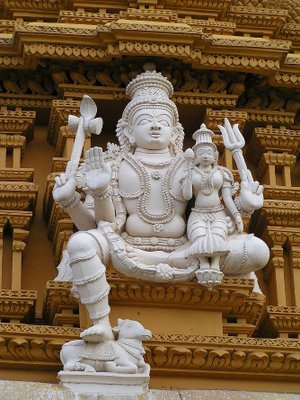
Nanjundeshwara Temple / Srikanteshwara Temple - Nanjangud

Nanjangud -close to Mysore - is famous for its Nanjundeshwara (Shiva) temple. A 1000+ year old temple from the days of Ganga's. And seems to have had major royal patronage all through. It reflects in the grandeur of the temple, exquisite sculpture, two big wooden chariots, and idols of numerous kings & queens.

This Nanjangud temple is dedicated to Nanjundeshwara or Srikanteshwara, who is Lord Shiva and He is called so as Lord Shiva swallowed the poison which originated while Great Churning of the Ocean. The temple had been under frequent expansion in phases and contributions from different rulers of the region for about 10 centuries by Gangas, Cholas, Hoysalas, Krishnadevaraya, Dalavoys and Wodeyaras from 9th century to 19th century.  When Tippu Sultan's Royal elephant had lost its eyesight, he worshiped Lord Nanjundeshwara and had faith in Him. The eyesight of the elephant got recovered and Lord Nanjundeshwara was called as "Hakim Nanjundeshwara" by Tippu Sultan. Tippu Sultan then donated a Shiva Lingam made of jade (precious green stone) along with an emerald necklace to the temple. Hakim means doctor, Lord Nanjundeshwara is also called as "Vaidya Nanjundeshwara" and is even today said to be a healer for his devotees.

This temple is situated on right banks of Kapila (Kabini) River and is one of the oldest temples in India. The Shiva Linga in the temple is believed to be installed by the sage Gauthama who had stayed here for some time. This Shiva Linga was also worshiped by Parashurama when he had stayed for some time in this town on his journey to get cleansed from the sin of beheading his mother.

A major event in the pilgrim town is the Rathotsava or the Chariot festival of Nanjundeshwara held twice every year, locally known as Dodda Jathre and Chikka Jathre. Idols of Lord Nanjundeshwara, Goddess Parvathi, Lord Ganapathi, Lord Subramanya and Lord Chandikeshwara are kept in five separate chariots and a traditional puja's are performed to the idols early in the morning on the day of Jathre. After the puja chariots are flagged off. Thousands of devotees pull the Chariots carved in the wood, through the streets of the old city.

Nanjangud Temple Timings:

Morning: 6am to 1pm
Evening: 4pm to 8pm.
Temple will be open from
Morning 6am to Evening 8pm
on Special Days and Mondays. 


Sri Veeranarayana Temple (Warangal)

Sri Veeranarayana Temple, Sri Veeranarayana Temple tours, Visit Sri Veeranarayana Temple of Andhra PradeshSri Veeranarayana Temple is constructed in the Chalukyan style around 1104 AD. Located between Hyderabad and Warangal, Kolanupaka is famous for the 2000 year old Jain Mahavir Mandir, with its 1.5 meters high image of Mahavira. Besides the Jain temple, other temples at Kolanupaka are the Shree Veeranarayan temple, and the Shree Someshwara temple.

Devi Puram Temple

Description
Map data ©2008 AND, Europa Technologies - Terms of Use
Map
Satellite
Hybrid
Click (+) to zoom in, Click (-) to zoom out, Click arrows to move the map

Devipuram temple complex located near Visakapatnam, Andhra Pradesh, India. Belonging primarily to the Shakta school of Hinduism, it is dedicated to the goddess Sahasrakshi ("she who has a thousand [infinite] eyes"; a form of Lalita Tripurasundari or Parvati); and her consort Kameshwara (Shiva).

Birla Mandir (Hyderabad)

The elegant modern Birla Mandir built of white marble stands on Naubat Parbat a little hill in the center of town where once the 'Naubat' or drums were sounded and royal proclamations read out. From top of the hill is another beautiful view of the town and at distance the rocky Golconda fort is visible. The prime diety here is Lord Venkateshwara and the idol in the temple is a copy of the one at Tirupati.

Overlooking the Tank Bund, the Birla Mandir presents an arresting sight when illuminated in the evening. This magnificent structure built completely out of marble from Rajasthan, stands atop the Kala Pahad, the twin hillock of the Naubat Pahad. Built by Birla Foundation over a span of ten years, the main temple is dedicated to Lord Venkatehwara.

Birla Mandir combines the architectural styles of the Southern and Northern Indian temples. The intricately carved gopurams (tower) at the base are in typical South Indian style, while the smooth sikhara (dome) at the top is in the North Indian Rajasthani style. The temple has beautiful marble carvings and some of them illustrating verses from the Ramayana. The inner shrine of the temple is a replica of the Venkateswara temple at Tirupati.

The Birla Mandir presents a colourful spectacular sight when illuminated at night. A trip to Hyderabad remains incomplete without a visit to the enchanting Birla Mandir

Significance
This is a modern temple (consecrated in 1976) built of white marble on top of a hill, dominating the skyline of Hyderabad. The Birlas (industrialists who have also built several temples in India in this century) built this temple. The presiding deity here is Venkateswara (Vishnu).

Architecture
This temple displays a mixture of architectural styles. A Rajagopuram built in the South Indian style greets the visitors. The tower over the main shrine of Venkateswara called the Jagadananda vimanam is built in the Orissan style while the towers over the shrines of the consorts are built in the South Indian style. The brass flagstaff rises to a height of 42 feet.

Other shrines in the temple
The consorts of Venkateswara Padmavathi and Andal are housed in separate shrines.

Worship and festivals
Although modern in construction worship is carried out as per the traditional Agama rules, the Pancharatra Agama in particular.

A number of superior steps lead the visitor to the sanctum sanctorum. Along the winding path are many a marble statue of gods and goddesses of Hindu mythology located in the midst of verdant gardens, full of blossoms. The Birla Mandir presents a colorful spectacular sight when illuminated at night.

The Temple is open for Visitors from
7 a.m. to 12 noon 3 p.m. to 9 p.m. all days of the week.

Kalahasti

This ancient temple dedicated to Shiva is one of the Pancha Bhoota Stalams (temples celebrating Shiva as the embodiment of the primary elements), air being the element in case here, the other five temples being Tiruvannamalai (Fire), Chidambaram (Space),Tiruvanaikkaval (Water) and Kanchipuram (Earth) respectively.

Kalahasti is located near the pilgrimage town of Tirupati and is visited by thousands of pilgrims. This temple is also associated with Rahu and Ketu, (of the nine grahams or celestial bodies in the Indian astrological scheme).

s0891.jpg (54742 bytes)

Antiquity: This temple has been referred to in pre-Christian Tamil literature. The Tamil Saivite saints of the 1st millennium CE have visited this temple and sung its fame. The adjoining hill Dakshina Kailasam has many a fine Pallava carving.

The Tamil Cholas and the Vijayanagara Rulers have made several endowments to this temple. Adi Sankara is said to have visited this temple and offered worship here. There are Chola inscriptions in this temple which date back to the 10th century CE.

The Telugu poem 'Sri Kalahasti Satakam' explains the traditions associated with this temple.Muthuswamy Deekshitar, one of the foremost composers in the Karnatic Music Tradition has sung the glory of this temple in his kriti 'Sree Kaalahasteesa'.

Other works on this temple include the Sree-Kalattipuranam of the three brothers Karunapprakasar, Sivapprakasar and Velappa Deekshitar, Tirukkalattipuranam by Aanandakoottar of Veerainagar and Tirukkalatti Ula by Seraikkavirayar.

Architecture: The vast west facing Kalahastiswara temple is built adjoining a hill, and on the banks of the river Swarnamukhi. At some points, the hill serves as the wall of the temple. The temple prakarams follow the contour of the adjoining hill and hence the temple plan is rather irregular. North of the temple is the Durgambika hill, south is the Kannappar hill and east is the Kumaraswamy hill.

Krishnadevaraya built a huge gopuram, a few feet away from the entrance to the temple. The entrance to the temple is crowned with a smaller tower. There is an underground Ganapati shrine in the outer prakaram, while in the innermost prakaram are the shrines of Shiva and Parvati.

The present structure of the temple is a foundation of the Cholas of the 10th century, as testified by inscriptions; improvements and additions were made during the subsequent years of the Chola rulers of Tamilnadu and the Vijayanagar emperors.

The Manikanteswarar temple, also in Kalahasti dates back to the period of Raja Raja Chola I (early 11th century), and it was reconstructed in stone in 1196 by Kulottunga III. Shiva here is also referred to as Manikkengauyudaiya Nayanar. There is also a Vishnu shrine in this temple.

Legends associated with this temple: The legend here is similar to that of the Jambukeswara temple at Tiruvanaikka. Shiva is said to have given salvation to a spider, elephant and a serpent who were ardent devotees of the Shiva Lingam located here. The spider is said to have attained salvation in Kritayuga (the first of the four yugas in the Hindu tradition), while the elephant and the snake were devotees in Treta Yugam, the succeeding aeon. The elephant's devotional outpouring was a source of disturbance to the serpent's display of devotion and vice versa, resulting in animosity between the two, until Shiva's intervention gave both the devotees their liberation.

Kannappa Nayanaar, a hunter is said to have been a great devotee of Kalahasteeswarar. Legend has it that he offered his own eyes to the Shivalingam, and for this reason earned the name Kannappan (his original name being Thinnan), and the distinction of having his statue adorn the sanctum. Nakkiradevar, Indra, Rama, Muchukunda and others are believed to have worshipped Shiva at this temple.

Festivals: Maha Shivaratri which occurs in the Tamil month of Maasi (Feb 15 through March 15) is one of the greatest festival seasons here, and the celebrations are marked by processions of the deities. The fifth day of the festival in the month of Maasi coincides with the Maha Shivaratri.

Access and Accomodation: Tirupati (30km) is the nearest airport and is perhaps the most convenient base for visiting Kalahasti as it (Tirupati) is endowed with several modern lodging facilities. A one day trip from Chennai is also possible, as Kalahasti is well connected by road with Tirupati and with Chennai and is only a four to five hour drive from Chennai. If well planned, Tirupati, Tirumala and Kalahasti can be covered in a day's trip from Chennai by car.

Sri Sailam

This is one of the greatest Saivite shrines in India and it constitutes one of the 12 Jyotirlingam shrines of Shiva. The presiding deities here are Mallikarjuna (Shiva) and Bhramaramba (Devi).

This is an ancient temple with fort like walls, towers and a rich endowment of sculptural work. This huge temple built in the Dravidian style with lofty towers and sprawling courtyards is one of the finest specimens of Vijayanagar architecture.

srisailam.jpg (8857 bytes)

The Satavahanas of the 2nd century AD have referred to it and the Saivite Tamil Saints have sung its glory. The Kakatiyas and the Vijayanagar kings (esp Krishnadevaraya) have made several endowments here. This temple is of immense religious, historical and architectural significance.

sank.gif (38519 bytes)

Antiquity The origins of this temple are buried in antiquity. The Skanda Purana has a chapter dedicated to it. The great religious leader Aadi Sankara is said to have visited this shrine and composed his immortal Sivananda Lahiri here. Praise of this temple has been sung by the Tamil Saint poets of the past millennium.

The shrine dedicated to Bhramaramba is considered to be of great significance. Legend has it that Durga is said to have assumed the shape of a bee and worshipped Shiva here, and chose this place as her abode.

Temples in the vicinity:

1. Tripurantakam to the east of Sree Sailam.

2. Siddavatam of Cuddapah district to the South

3. Alampur Navabhrama temples in Mahboobnagar district to the West

4. Umamaheswaram in Mahboobnagar district to the North.

5. Paladhara Panchadara - the spot where Adi Sankara is said to have meditated.

6. Hatakeswaram: another Shiva temple near Paladhara Panchadara where the lingam was originally made of gold.

7. Sakthi Ganapathi temple: It is considered important to visit this temple before visiting Sri Sailam.

8. Kailasa Dwaram: The main entrance to Sri Sailam for those trekking to the temple

9. Sikharam: There is a hill temple dedicated to Shiva at a height of 2850 feet above sea level in the Nallamalai hills

10. Patalaganga: is where the bathing ghats associated with Sri Sailam are located. (Krishna river).

Tripurantakam, Siddavatam, Alampura and Umamaheswaram are considered to be the four gateways to Sri Sailam.

jl2.gif (12735 bytes)

Ahobilam Temple - A heaven in earth

Location: Ahobilam near Nandyal(Andhra Pradesh) (Vada Naadu)
Vishnu: Narasimha (Prahladavaradan),
Taayaar:
Amritavalli
Theertham:Indra Theertham, Narasimha Theertham
Paasuram :Tirumangaialwar
Vimaanam:Guhai Vimanam
Travel Base:Cuddappah


Ahobilam is one of the most venerated Vaishnava temples enshrining Narasimha. It is located near Nandyal in Andhra Pradesh. It is accessed from Cuddappah on the Chennai Mumbai railroad. Forty miles from Cuddapah is Allagedda, and there are bus routes to Ahobalam from Allagedda. Other possible routes, are Nandyal-Allagadda-Ahobalam and Dhone-Banganapalli-Koilakuntla-Ahobalam. It is referred to as the Nava Narasimha Kshetram, and is the seat of the Ahobila Mutt.

Singavelkunram, praised in Tirumangai Alwar's decad of 10 verses in Tamil, is the Ahobila Divya Desam, enshrining as many as nine images of Narasimha - and is one of the two Divya Desams in Andhra Pradesh. The Puranas state thet the Nallamalai hills from Kurnool to Chittoor district are a personification of Adiseshan


Ahobilam or Ahobalam is a major center of pilgrimage in south India. According to the legend, this is where Lord Narasimha blessed Prahlada and killed the demon Hiranyakashipa. It is an important place of worship for Vaishnavas. It is one of the 108 Divya desam.

Ahobilam is located in the Nandyal Taluka of Kurnool district in Andhra Pradesh, India. It is located at a distance of 40 km from Nandyal, and is conveniently accessibly by bus from Nandyal, Kurnool and Hyderabad. Ahobilam is not connected by rail; the closest railway stations are Nandyal (on the Bangalore-Vizag(Vishakapatnam) route) and Cuddapah (on the Mumbai-Chennai route).

There are nine temples around the Nellimala Forest range. Few temples can be reached through trekking. Some temples are inside the cave. Some temples are very difficult to trek. However, this is disputed by other historical data, which indicates that Multan in Pakistan was formerly Mulastan, which used to have a large Narasimha worshipping Vaishnava community. The temples were later destroyed by Islamic invaders, and the residents killed or forcibly converted to Islam. The holy shrines of Ahobilam (all the Nava are Nine Nrusimhars) are eulogized by Thirumangai Mannan. Hence Ahobilam is one of the 106 Divya Desams. The hereditary powers of the temple rest with the Pontiff HH Azhagiyasingar of Ahobila Mutt. Currently the 45th Jeer of this lineage is the reigning Pontiff . The Azhagiyasingars have the unique privilege of being Aradhakars to a Divya Desam (a distinction no other Pontiff enjoys). Occasionally when HH Jeer performs Mangalasasanam (pays respects at the temple) at Ahobilam, the Serthi Utsavam is performed (the Moolavar of Malola Nrusimhar and the Utsavar) are united. This place was visited by Lord Chaitanya Mahaprabhu and it is located in remote place far away from main roads. The Nellimala hills are personified as Adisesha with his head at Tirumala, middle at Ahobilam and the tail at Srisailam.

According to legend it is believed that when the Devas saw the manifestation of Lord Vishnu as half lion half man they shouted "Ahobala" (great strength) as well as "Ahobila" (great cave in which the current sanctum is). Hence this place could be called "Ahobalam" or "Ahobilam". Another Legend talks about that Lord Garuda did penance to see Lord Vishnu in Lord Narasimha form. Hence, Lord Narasimha took nine different forms in this hill. Lord Narasimha in nine forms are

According to legend it is believed that when the Devas saw the manifestation of Lord Vishnu as half lion half man they shouted "Ahobala" (great strength) as well as "Ahobila" (great cave in which the current sanctum is). Hence this place could be called "Ahobalam" or "Ahobilam". Another Legend talks about that Lord Garuda did penance to see Lord Vishnu in Lord Narasimha form. Hence, Lord Narasimha took nine different forms in this hill. Lord Narasimha in nine forms are

According to legend it is believed that when the Devas saw the manifestation of Lord Vishnu as half lion half man they shouted "Ahobala" (great strength) as well as "Ahobila" (great cave in which the current sanctum is). Hence this place could be called "Ahobalam" or "Ahobilam". Another Legend talks about that Lord Garuda did penance to see Lord Vishnu in Lord Narasimha form. Hence, Lord Narasimha took nine different forms in this hill. Lord Narasimha in nine forms are

According to legend it is believed that when the Devas saw the manifestation of Lord Vishnu as half lion half man they shouted "Ahobala" (great strength) as well as "Ahobila" (great cave in which the current sanctum is). Hence this place could be called "Ahobalam" or "Ahobilam". Another Legend talks about that Lord Garuda did penance to see Lord Vishnu in Lord Narasimha form. Hence, Lord Narasimha took nine different forms in this hill. Lord Narasimha in nine forms are

According to legend it is believed that when the Devas saw the manifestation of Lord Vishnu as half lion half man they shouted "Ahobala" (great strength) as well as "Ahobila" (great cave in which the current sanctum is). Hence this place could be called "Ahobalam" or "Ahobilam". Another Legend talks about that Lord Garuda did penance to see Lord Vishnu in Lord Narasimha form. Hence, Lord Narasimha took nine different forms in this hill. Lord Narasimha in nine forms are

According to legend it is believed that when the Devas saw the manifestation of Lord Vishnu as half lion half man they shouted "Ahobala" (great strength) as well as "Ahobila" (great cave in which the current sanctum is). Hence this place could be called "Ahobalam" or "Ahobilam". Another Legend talks about that Lord Garuda did penance to see Lord Vishnu in Lord Narasimha form. Hence, Lord Narasimha took nine different forms in this hill. Lord Narasimha in nine forms are


1. Varaha Narasimhar
2. Malola Narasimhar
3. Yogananda Narasimhar
4. Pavana Narasimhar
5. Karaancha Narasimhar
6. Chakra Vada Narasimhar
7. Bhargava Narasimhar
8. Jwala Narasimhar
9. Ahobila Narasimhar

Temples which is present in cave does not have any specific prasadam. Pilgrims offer some fruits for the Lord inside the cave. The temple which is accessible has the Vaishanava traditional prasadams. The local tribes used to offer their traditional offerings to Lord Narasimha. Narasimha Jayanthi will be celebrated with pomp and glory. The annual festival is during the Tamil month of Maasi. The local tribals celebrate the marriage of Goddess Mahalakshmi as ChenchuLakshmi and Lord Narasimha.


Deities:

This Nava Narasimha Kshetram enshrines Ahobila Narasimhan, Varaha Narasimhan, Malola Narasimhan, Yogananda Narasimhan, Bhavana Narasimhan, Kaarancha Narasimhan, Chakra Vada Narasimhan, Bhargava Narasimhan and Jwala Narasimhan. In the temple at the foothills, the Moolavar Prahladavaradan in a seated posture facing east; there are festival images of 8 of the Narasimhas, other than malola Narasimha. The festival image of Malola Narasimha is located in the Ahobila Mutt. The Moolavar in the Ahobila Mutt is Lakshmi Narasimha, while the utsavar is Rama.

Upper Ahobalam is 2800 feet above sea level.It is an arduous trek to upper Ahobilam from the foothills. The Lakshmi Narasimhar temple at the lower level, has mandapams, with remnants of fine sculpture from the Vijayanagar period. Upper Ahobilam enshrines Ahobila Narasimhan and Ugra Narasimhan. The moolavar images were the only shrines of worship during the period of the Chalukyan king Vikramaketu, while it was during the period of Prataparudra that festival images were made. Krishna Devarayar is known to have made endowments here.

The two crests of the hill are caled Vedadri and Garudadri, through which the Bhavanasini Thirtham flows. There is a pillar near the Ugra Narasimhar and the Guha Narasimhar shrine; said to be the pillar, facing which the demon Hiranyakasipu asked Prahlada to demonstrate the omnipresence of Vishnu.

Legend has it that Rama, separated from Sita worshipped Lakshmi Narasimhar here. Legend has it that Garuda, desirous of seeing the Narasimha form of Vishnu worshipped him here, and that Vishnu manifested himself as nine forms of Narasimha. Mahalakshmi is believed to have reincarnated into a family of hunters as Senjulakshmi, and married Narasimhar here. This event is commemorated in the annual festival in the tamil month of Maasi, when the local tribe actively participates in the festivities.


Travel & Stay:

Ahobilam is located at 15.1333° N 78.7167° E.[1] It has an average elevation of 327 meters (1076 feet).


There are three routes reaching Ahobilam.
1. Pilgrims from the north can get down at Nandyal, which is a Railway junction from Kurnool, and travel by bus to Allagadda and Ahobalam, which is only thirty miles from Nandyal.

2. The second route is from Dhone which is another railway station and from which one can reach Ahobilam via Banganapalli and Koilakuntla.

3. The other and easy route is to get down at Cuddapah which is a district headquarters and an important railway station in the Madras - Bombay route. From Cuddapah one has to travel to Allagadda, which is forty miles over and from there by bus to Ahobilam