Showing posts with label lord shiva. Show all posts

Nanjundeshwara Temple / Srikanteshwara Temple - Nanjangud

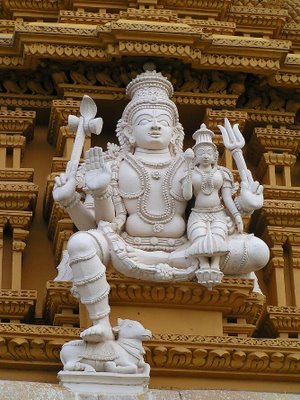
Nanjangud -close to Mysore - is famous for its Nanjundeshwara (Shiva) temple. A 1000+ year old temple from the days of Ganga's. And seems to have had major royal patronage all through. It reflects in the grandeur of the temple, exquisite sculpture, two big wooden chariots, and idols of numerous kings & queens.

This Nanjangud temple is dedicated to Nanjundeshwara or Srikanteshwara, who is Lord Shiva and He is called so as Lord Shiva swallowed the poison which originated while Great Churning of the Ocean. The temple had been under frequent expansion in phases and contributions from different rulers of the region for about 10 centuries by Gangas, Cholas, Hoysalas, Krishnadevaraya, Dalavoys and Wodeyaras from 9th century to 19th century.  When Tippu Sultan's Royal elephant had lost its eyesight, he worshiped Lord Nanjundeshwara and had faith in Him. The eyesight of the elephant got recovered and Lord Nanjundeshwara was called as "Hakim Nanjundeshwara" by Tippu Sultan. Tippu Sultan then donated a Shiva Lingam made of jade (precious green stone) along with an emerald necklace to the temple. Hakim means doctor, Lord Nanjundeshwara is also called as "Vaidya Nanjundeshwara" and is even today said to be a healer for his devotees.

This temple is situated on right banks of Kapila (Kabini) River and is one of the oldest temples in India. The Shiva Linga in the temple is believed to be installed by the sage Gauthama who had stayed here for some time. This Shiva Linga was also worshiped by Parashurama when he had stayed for some time in this town on his journey to get cleansed from the sin of beheading his mother.

A major event in the pilgrim town is the Rathotsava or the Chariot festival of Nanjundeshwara held twice every year, locally known as Dodda Jathre and Chikka Jathre. Idols of Lord Nanjundeshwara, Goddess Parvathi, Lord Ganapathi, Lord Subramanya and Lord Chandikeshwara are kept in five separate chariots and a traditional puja's are performed to the idols early in the morning on the day of Jathre. After the puja chariots are flagged off. Thousands of devotees pull the Chariots carved in the wood, through the streets of the old city.

Nanjangud Temple Timings:

Morning: 6am to 1pm
Evening: 4pm to 8pm.
Temple will be open from
Morning 6am to Evening 8pm
on Special Days and Mondays. 


Kurangaaduturai Temple

Kurangaaduturai Temple, Visit Kurangaaduturai Temple of Tamilnadu, Temple tour of Kurangaaduturai Temple, Religious place
Ten Kurangaaduturai (Aaduturai) and Vada Kurangaaduturai are the two important Shivastalams, where Sugreevan and Vaali are believed to have worshipped Lord Shiva. Vada Kurangaduturai is known so because of its location, north of the river Kaveri, near Tiruvaiyaru. Ten Kurandagudurai gets its name from its location south of the river Kaveri.

Hanuman and Sugreeva worshipped Lord Shiva here, and Shiva is said to have revealed a vision of his cosmic dance to Sugreeva. It is also believed that Rama killed Vaali at Ten Kurangaaduturai. It is believed that Hanuman who is said to have lost his tail at Rameshwaram regained it at Vada Kurangaaduturai.

Ten Kurangaaduturai was rebuilt by Sembiyan Mahadevi - the Chola queen (10th century); in the rebuilt structure, earlier inscriptions from the older structure were re-engraved. This temple with 2 Prakarams has a large RajaGopuram. The niche images here are those of Vinayaka (also spelt as Vinayak), Nataraja, Agastya, Dakshinamurti, LinGodbhava, Bhrama, Bhikshatana, Alinganamurti (Lord Shiva and Parvati) and Durga. The sun's rays illuminate the sanctum for three days in a year. Festivals celebrated here include Arudra Darisanam, Navaratri and Shivaratri.

Vada Kurangaaduturai was adminstered by the Thanjavur Royal Palace. A 5-tiered RajaGopuram adorns the entrance to this temple with 2 Prakarams and a spacious front courtyard. Stucco figures representing the legends associated are seen in this temple and a stone image of Vaali worshipping Lord Shiva adorns the sanctum. Inscriptions from the Imperial Chola period are seen in this temple. Stone images of Nataraja and Shivakami adorn the Natarajar Sabhai shrine also known as "Aadi Chidambaram, Naalikeravanam".

Kaliyar Koil Temple


Kaliyar Koil Temple, Visit Kaliyar Koil Temple of Tamilnadu, Temple tour of Kaliyar Koil Temple, Religious place
n the territory ruled by kings of the Pandya dynasty, there were 14 sacred shrines of Lord Shiva, which have been visited by the three great Tamil saints, Sambandar, Appar and Sundarar. Of these fourteen places Tirukanapper, presently known as "Kaliyar Koil" is an important shrine and is known by many other names.

Kaliyar Koil is situated in Devakottai town, five miles away from Shivaganga on the railway line from Karaikudi to Rameshwaram. The presiding deity, Lord Shiva, in temple is known as "Kaleesar". The Gopuram of the temple is not only gigantic in stature but also immensely imposing, being visible from a great distance. As the Gopuram has become very old, devoted people have joined together to renovate it, which is being done now.

It is said that Sage Agastya came to this place and took bath in the holy Teertha of Shivaganga, where he visualized the real form of Lord Shiva.

Lord Shiva once cursed Parvati Devi for closing his eyes out of jest and throwing the entire universe into complete darkness, which caused untold sufferings to the people. As a result of the curse, she had to spend her time on the earth in the form of Kali, worshipping Lord Shiva.

At that time, there was a demon by name Chandasuran who was harassing all the Devas (Gods) including Vishnu, Brahma and Indra. All of them approached Lord Shiva for help and according to his advice they approached Kali.

The Mother of the Universe took pity on them and killed the demon in a fierce battle and relieved them of their sufferings. The place where the Devas first met the Devi, came to be known as "Kandadevi" (Kanda means 'seen' in Tamil', - The fort which was built by the Devas for the Devi to reside in is known as "Devakottai" (Kottai means fort).

Kaliyar Koil Temple, Visit Kaliyar Koil Temple of Tamilnadu, Temple tour of Kaliyar Koil Temple, Religious place The present town of Devakottai has derived its name thus. The place where the demon was conquered is known as "Vetriyur" (Vetri means victory); the place where the flag-mast of the Demon's chariot was broken into two is known as "Kodikulam" (Kodi means flag and Kulam means tank); the place where flowers were showered by the Devas on the Devi returning with victory after killing the Demon, is known as "Poongudi" (Poo - means flowers).

After the terrible fight with the Demon, Kali reached this holy place, worshipped Lord Shiva and at last got back her original form of Parvati and attained re-union.

Innambar Temple

Innambar Temple, Visit Innambar Temple of Tamilnadu, Temple tour of Innambar Temple, Religious place of TamilnaduInnambar lies 5-km to the north west of Kumbakonam. The temple covers an area of about 2 acres. Agasthyar was thought Tamizh (grammar of Tamil) at this temple and he brought it to the world. A very big Garbhagraham, which could allow an elephant to perform puja can be seen here. Airavatam, the mythological elephant is said to have worshipped Lord Shiva here. A five-tiered RajaGopuram adorns the entrance to this temple with 2 Prakarams, while a Gajaprishta Vimanam with 5 Kalasams crowns the sanctum. Stucco images on the Vimanam illustrate the Stala Puranam.The ShivaLinga and the entrances to the sanctum are huge and the Nataraja image is of great workmanship. Nityakalyani Amman is situated to the right of Lord Shiva, while there is a separate shrine for Sugandha Kundalambal in the outer Prakaram. Nityakalyani Amman's shrine located close to Lord Shiva's shrine is said to represent the Kalyanakkolam of Lord Shiva. Inscriptions from the Chola and Vijayanagar periods are found in this temple. Four worship services are offered each day here. Some volunteers who belonged to "Thaayumaanavar Narpani Manram", Trichy, renovated the temple.

Kudumianmalai Temple

Kudumianmalai Temple, Visit Kudumianmalai Temple of Tamilnadu, Temple tour of Kudumianmalai Temple, Religious place Kudumianmalai is located at a distance of 20-km from Pudukkottai. The presiding deity is Sikhagireeswara. There are beautiful sculptures and a thousand pillar-hall in the temple. The temple is noted for numerous inscriptions. Remarkable among them is the one relating to a musical treatise of the Mahendra Varma Pallavan, who experimented the Sapthaswara in a Veena called "Parivadini" with 8 strings. There is also a rock-cut cave temple called "Melakkoil", which was excavated during the time of Mahendravarma Pallavan. The Anna Agricultural Farm and Agriculture Research Institute are the other interesting features of this place.

Devi Puram Temple

Map data ©2009 AND, Europa Technologies - Terms of Use
Map
Satellite
Hybrid

Devipuram temple complex located near Visakapatnam, Andhra Pradesh, India. Belonging primarily to the Shakta school of Hinduism, it is dedicated to the goddess Sahasrakshi ("she who has a thousand [infinite] eyes"; a form of Lalita Tripurasundari or Parvati); and her consort Kameshwara (Shiva).

Source: http://en.wikipedia.org/

Vaikom Mahadevar Temple

The Vaikom Mahadevar temple is one of the most celebrated Shiva temples in South India. Vaikom is located at a distance of 33km south of Ernakulam and 40 km north of Kottayam on the railroad between Ernakulam and Tiruvanandapuram.

Offering of prathal, or food is a form of worship here. In ancient times, feasts used to be cooked and offered to all devotees; Vaikom Mahadever is also referred to as Annadaana Prabhu.

The Deity: Shiva - Vaikom Mahadevar manifests himself as Dakshinamurthy in the panthirathi pooja in the morning. He is worshipped as Kiraata Murthy during the Uchcha pooja at noon and as Satchitananda in the evening.

Legend has it that Khara (of the Khara Dhooshana demon duo) of Ramayana worshipped Shiva at Chidambaram and obtained from him three Shivalingams and journeyed holding one shivalingam on each hand and one in his mouth. He sojourned at Vaikom, and set the shivalingam on the ground and to his dismay realized that it had gotten rooted to the ground. Kharan therefore installed the other two shivalingams at Ettumanur and Kaduthuruthy. He entrusted the shivalingam at Vaikom to the care of Vyagrapadar. Vaikom therefore acquired the name Vyagrapuri which ultimately became Vaikom for short.

At Triprayar, north of here (near Thrissur), Rama is held in worship as the slayer of the demon Khara.

Legend has it that Shiva appeared in front of Vyagrapadar under a peepul tree, south of the eastern gateway on the morning of Ashtami in the dark fortnight in the month of Scorpio. This incident is commemorated in the annual Vaikattu Ashtami festival.

Legend also has it that Parasurama, the incarnation of Vishnu built this temple and set up the worship protocol here.

It is believed that the Tiruvilaiyaadal associated with the tamil saint poet Manikkavaacakar, where jackals were miraculously transformed into horses - occurred here.

The temple: The elliptical sanctum here is covered with a copper plated roof crowned with a golden kalasam. The height of the wall of the sanctum is just about a third of that of the roof. The building dates back to the 11th century, and the wooden panels and the murals date back to the 15th and 18th centuries respectively. The mukhamandapam in front of the sanctum houses the nandi. The wall of the inner prakaram is lined with columns of lamps (vilakkumaatam) on a wooden framework. The flagstaff rises to a height of 317 feet. The Uttuppura or the dining hall is on the northern side of the sanctum. There is a shrine to Pananchikkal Bhagawati in the outer prakaram.

Festivals: As mentioned before, the annual festival is celebrated in the month of scorpio, and the twelfth day of the festival is Vaikkattu Ashtami. Each day witnesses special rituals, elephant processions, music and dance performances etc. The Ashtami festival involves a special darshan in the wee hours of the morning under the peepul tree, a feast at noon and a procession at night from the nearby Udayanapuram Subramanya temple. This procession involves the meeting of Shiva and Subramanya in celebration of Subramanya's victory over the demons. Deities from nearby temples also converge at this procession amidst elephants, lighted torches and musicians. The two kilometer long procession takes about 3 hours to complete and it reaches the northern gate of the Vaikom temple at about 130 AM. Subramanya and Vaikom Mahadevar then circumambulate the temple and then a touching farewell is enacted as Subramanya returns to Udayanapuram.

The aaraattu festival on the 13th day takes place at a tank, near the temple, and the deity from Udayanapuram participates in it too.

No poojas are carried out on the Ashtami festival inside the temple as it is believed that Mahadeva fasts, feeds guests and prays for his son's victory in the battle against demons.

Vaikom Mahadevar Temple

The Vaikom Mahadevar temple is one of the most celebrated Shiva temples in South India. Vaikom is located at a distance of 33km south of Ernakulam and 40 km north of Kottayam on the railroad between Ernakulam and Tiruvanandapuram.

Offering of prathal, or food is a form of worship here. In ancient times, feasts used to be cooked and offered to all devotees; Vaikom Mahadever is also referred to as Annadaana Prabhu.

The Deity: Shiva - Vaikom Mahadevar manifests himself as Dakshinamurthy in the panthirathi pooja in the morning. He is worshipped as Kiraata Murthy during the Uchcha pooja at noon and as Satchitananda in the evening.

Legend has it that Khara (of the Khara Dhooshana demon duo) of Ramayana worshipped Shiva at Chidambaram and obtained from him three Shivalingams and journeyed holding one shivalingam on each hand and one in his mouth. He sojourned at Vaikom, and set the shivalingam on the ground and to his dismay realized that it had gotten rooted to the ground. Kharan therefore installed the other two shivalingams at Ettumanur and Kaduthuruthy. He entrusted the shivalingam at Vaikom to the care of Vyagrapadar. Vaikom therefore acquired the name Vyagrapuri which ultimately became Vaikom for short.

At Triprayar, north of here (near Thrissur), Rama is held in worship as the slayer of the demon Khara.

Legend has it that Shiva appeared in front of Vyagrapadar under a peepul tree, south of the eastern gateway on the morning of Ashtami in the dark fortnight in the month of Scorpio. This incident is commemorated in the annual Vaikattu Ashtami festival.

Legend also has it that Parasurama, the incarnation of Vishnu built this temple and set up the worship protocol here.

It is believed that the Tiruvilaiyaadal associated with the tamil saint poet Manikkavaacakar, where jackals were miraculously transformed into horses - occurred here.

The temple: The elliptical sanctum here is covered with a copper plated roof crowned with a golden kalasam. The height of the wall of the sanctum is just about a third of that of the roof. The building dates back to the 11th century, and the wooden panels and the murals date back to the 15th and 18th centuries respectively. The mukhamandapam in front of the sanctum houses the nandi. The wall of the inner prakaram is lined with columns of lamps (vilakkumaatam) on a wooden framework. The flagstaff rises to a height of 317 feet. The Uttuppura or the dining hall is on the northern side of the sanctum. There is a shrine to Pananchikkal Bhagawati in the outer prakaram.

Festivals: As mentioned before, the annual festival is celebrated in the month of scorpio, and the twelfth day of the festival is Vaikkattu Ashtami. Each day witnesses special rituals, elephant processions, music and dance performances etc. The Ashtami festival involves a special darshan in the wee hours of the morning under the peepul tree, a feast at noon and a procession at night from the nearby Udayanapuram Subramanya temple. This procession involves the meeting of Shiva and Subramanya in celebration of Subramanya's victory over the demons. Deities from nearby temples also converge at this procession amidst elephants, lighted torches and musicians. The two kilometer long procession takes about 3 hours to complete and it reaches the northern gate of the Vaikom temple at about 130 AM. Subramanya and Vaikom Mahadevar then circumambulate the temple and then a touching farewell is enacted as Subramanya returns to Udayanapuram.

The aaraattu festival on the 13th day takes place at a tank, near the temple, and the deity from Udayanapuram participates in it too.

No poojas are carried out on the Ashtami festival inside the temple as it is believed that Mahadeva fasts, feeds guests and prays for his son's victory in the battle against demons.

Kozhikkode Tali Temple

The Kozhikkode Tali temple is an ancient one, dating back to the days of the Zamorin rule. The term Tali refers to a Shiva temple; however, the temple complex also houses a shrine to Krishna.

Legend has it that Parasurama, associated with several temples in Kerala, worshipped Shiva here.

Several legends associated with feudal rivalry, curses and relief from curses are associated with this temple. In its glorious days, this temple celebrated the Revathi Pattattaanam festival for seven days in the malayala month of Tulaa where learning and scholarship was celebrated with feasting and awards. The composer of Narayaneeyam (Guruvayur) is said to have been a recepient of awards at this festival. The Zamorin is also asociated with the pomp and splendor of the now extinct Mahamakam festival at Tirunavayi.

This temple suffered destruction at the hands of Tippu Sultan and Hyder Ali and was renovated in the 18th century. The current structure dates back to the period of the ruler Manavikraman.

The two storeyed sanctum has works of art in terms of stone sculptures and wood work with scenes from the puranas. In front of the sanctum is a chamber with intricate woodwork.

There are also shrines to Ganapati, Narasimha and Saasta.

In the north east segment of the temple complex is the Krishna shrine with its own set of mandapams and a flagstaff.

The 7 day long annual festival commences on the Malayala new year. Five worship services are offered each day.

Ettumaanur Mahadevar Temple

The Ettumaanur Mahadevar temple is one of the most celebrated Shiva temples in Kerala, and is on the Ernakulam Tiruvanandapuram railroad south of Kottayam.

ettumanur.jpg (78864 bytes)

Legend has it that Khara (of the Khara Dhooshana demon duo) of Ramayana worshipped Shiva at Chidambaram and obtained from him three Shivalingams and journeyed holding one shivalingam on each hand and one in his mouth. He sojourned at Vaikom, and set the shivalingam on the ground and to his dismay realized that it had gotten rooted to the ground. Kharan therefore installed the other two shivalingams at Ettumanur and Kaduthuruthy. It is believed that visiting these triad of temples in a single day is of great significance.

Legend also has it that Khara installed an image of Krishna in the north western corner of this temple.

There are several other legends associated with this shrine. Legend has it that Shiva created a deer and set it to play in an island; when Parasurama reclaimed land from the sea, this island is said to have become part of what is Kerala now. The isle of the deer is referred to as Harinadweepa. The malayalam word for deer is Maan, and hence this place came to be known as Maanoor.

Legend has it that this is a very ancient shrine and that it was in wilderness thanks to a curse of Lomaharsha rishi, a disciple of Vyasa, and that worshipped was restored here by Vilwamangala swamy who is associated with several other temples in Kerala. Inscriptions testify to renovations that were carried out in the 16th century CE here.

The temple: The west facing temple here has a circular sanctum covered with a conical copper plated roof crowned with a kalsam. The mukhamandapam in front of the temple bears two images of Nandi, one of stone and another of metal. Although there is no shrine to Parvati, the rear of the sanctum is revered as Parvati's shrine.

A rectangular circumambulatory passage surrounds the sanctum. The sanctum bears wood carvings of superior workmanship portraying legends from the Ramayana and the Bhagavata puranam.

Also of great workmanship are the murals on the western entrance to the temple; mention must be made of the painting of the dance of Shiva.

There are also shrines to Saasta, Ganapati and Dakshinamurthy in the temple.

A golden staff, visible from a distance is in front of th e shrine.

At the entrance to the temple is a large metal lamp; visitors make offerings of oil and the soot that collects from the burning of the oil is believed to have medicinal value.

Festivals: The 10 day long festival in the malayala month of Kumbham concluding on the Ardra asterism is the temple's annual festival.

On the eigth day of the festival, the processional image of the deity is taken to a specially decorated site in the north east corner of the temple, when thousands throng to visit the shrine.

On this day, a unique treasure of the temple (offered by the Maharaja of Travancore) - the seven and a half elephants (ezhara pon aana) representing the eight dik paalakas or the guardians of the cardinal directions are displayed. Seven of these golden elephants are two feet in height while the eighth is a foot high.

Thiruvanchikkalam

Description: Tiru Anjaikkalam is the only Shivastalam in Kerala and in Chera Naadu which has been sung by the Nayanmars and is located in the vicinity of Kodungallur, near Thrissur. Kodunallur is well known for its famed temple to Bhagawati.

History: Cheraman Perumal, one of the 63 Nayanmars and a great friend of Sundaramoorthy Nayanar is said to have ruled with Kodungallur as his capital.Aadi Swathi (in the month of Cancer) is of festive significance commemorating Sundarar's association with the temple. Sundarar and Cheraman Perumal Nayanar are said to have left for Kailasam from here.The latter composed the Tirukkailaya Ula at Tirukkayilayam (Mount Kailash).

The Temple: In keeping with the Keralite architectural style, this temple has a conical copper plated Vimanam. This temple has a namaskara mandapam, and gopura dwarams on the east and the west. Cheraman Perumal's image is carved on the temple walls & there is a memorial to him nearby. A majestic tiered brass lamp adorns the temple. Dakshinamurthy, contrary to the name faces the East here. The sanctum is in the form of a chariot and there is no separate shrine for Ambal. Unlike most other Shiva temples in Kerala, there is an image of Nataraja here. Murals adorn the temple walls.

Tiru Aanaikkaa

Description: This well visited Shivastalam located in the vicinity of Tiruchirappalli and Srirangam This is one of the most revered temples to Shiva; it is one of the Panchabhoota Stalams signifying the 5 elements of wind (Kalahasti), water (Tiruvanaikka), fire (Tiruvannamalai), earth (Kanchipuram) and space (Chidambaram). The primordial element water, is represented by an undying natural spring in the sanctum. The saptastanams of this temple are Tiruchendurai, Tirupparaitturai, Tiruppainneeli, Tiruppaachilasramam, Tiruvedikkudi and Tiruvalaindurai.

Legends: There is said to have been a forest of Jambu trees near the Chandrateertha tank (filled with the water of the Kaveri) here and Shiva is said to have appeared under one of the trees as a Shiva Lingam. Legend has it that two devotees of Shiva were born under the influence of a curse as a white elephant and a spider. The elephant worshipped Shiva with flowers and water brought in its trunk (hence the name Tiru Aanaikka).

The spider worshipped the Lingam by spinning a web on top, to protect it from falling leaves. The elephants worship would destroy the spiders web, and the spiders web amounted to desecration in the eyes of the elephant leading to animosity between the two, of such proportion that a fight between them resulted in the death of both.

The spider was born again in the royal Chola family (in Uraiyur - during the Sangam period). An interesting tale is associated with his birth. His parents Subhadeva and Kamalavati prayed to Nataraja of Chidambaram for a male successor. The royal astrologer is said to have predicted an auspicious time for the birth of a successor who would be a ruler of great fame. The hour of birth approached sooner though and the royal queen bade her attendants to tie her legs and hang her upside down, with the aim of delaying the birth of the child. She achieved her objective although the royal offspring was born with reddened eyes, earning for himself the name 'Chenkannan' - the red eyed one. In his life time Ko Chenkannan is said to have been built several elevated temples - out of reach of elephants, keeping with the legend of his animosity with an elephant in his previous birth.

The stala vriksham is said to have grown out of a munivar, who offered his worship to Shiva.Akhilandeswari (Parvati) is said to have meditated upon Shiva here, and her shrine here, is considered to be of great significance.

It is believed that Akhilandeswari was originally an Ugra Devata of great fury, and Adi Sankaracharyar is said to have converted the fiery energy of the deity into a manifestation of peace. Shrines to Vinayaka and Subramanya face Akhilandeswari.

History: This temple has records of patronage from the Chola Pandya, Hoysala and the Madurai Naik kings. The temple is said to have been built by the Chola King Ko Chenkannan and it was of special significance to the Chola kings. Ko Chenkannan is praised by tamil literature for having built more than seventy temples - and he is historically placed in the Sangam period (the very early years of the Christian era).

Inscriptions from the tenth century AD testify to later Chola patronage. The Hoysalas who had a base near Samayapuram (near Tiruchi) built four temples in Northern Tiruvanaikkaval (Vallaleeswaram, Padmaleswaram, Narasimheswaram and Somaleswaram). The Pandyas and the Hoysalas contributed to the Eastern tower.

Adi Sankara is said to have visited the Akhilandeswari shrine. He is said to have adorned her with ear-rings bearing the symbol of the chakram. There is a shrine to Adi Sankara in this temple.

The Temple: This is a vast temple (18 acres) with lofty gopurams, 5 prakarams and ornate mandapams. The second and third prakarams date back to the 13th century. The dwajasthampa mandapam has grand sculptural work. There is an image of Ekapada Trimurthy representing the unity of Bhrama Vishnu and Shiva in this temple.

The Akhilandeswari shrine is located in the fourth prakaram. The Eastern tower with seven levels has fine sculptural specimen of musical scenes, while the Western tower has nine levels. The first prakaram has been renovated in this century.

Festivals: Annual festivals here include the Pankuni Bhrammotsavam, Vasanta Utsavam, the float festival in Thai (Capricorn) , Aadi Pooram (Cancer) and the Pancha Prakara festival. For more information please see the Templenet Special Feature on Tiruvanaikka.

Travel: Tiruchirappalli is connected by air with Chennai and with other cities. It is a major railway junction between Chennai and Madurai, and is also connected with Erode on the Chennai - Coimbatore line. Several trains link Tiruchi with Chennai and Madurai. Tiruchirappalli has several modern lodging facilities.

Other attractions here include the Rock Fort Temple (Uchhi Pillaiyaar and Taayumanavar) and the Sri Ranganathar Temple at Srirangam. The Regional Engineering College at Tiruchirappalli is one of the leading educational institutions in India. Samayapuram, near Tiruchi is home to the famous Mariyamman temple attracting thousands of worshippers.

Uraiyur

Description: . This is the second of the two Stlaams in Tiruchirappalli, the first being the Rock Fort Temple. Uraiyur was the ancient capital of the early Cholas and the ancient city is believed to have been destroyed by a sand storm. Pugazh Chola Nayanar and Go Chenkan Cholan were born here, as was Tiruppaanaazhwar. Also known as Mookkeeswaram this shrine is considered to be the 5th in the series of Tevara Stalams in the Chola kingdom located south of the river Kaveri.

Legends: Garuda, Kasyapa Muni and Karkotakan are said to have worshipped here. Shiva is said to have manifested himself in five different shades of color to Utanga Munivar (Ratna Lingam in the morning, Spatika Lingam at noon, Gold Lingam in the afternoon, Diamond lingam at night and Chitra lingam later on at midnight).

Uraiyur is also known as Kozhimanagaram as legend holds that a fowl blessed with divine powers defeated an elephant in an duel. Go Chenkan Cholan the builder of 78 Maadakkovils is said to have born here.

Several legends are associated with this temple and the one involving the merger of 6 Shivalingsms into one, is commemorated in the month of Vaikasi during the annual festival. This legend states that a Chola king saw the five daughters of Nagarajan worshipping a Shivalingam each, on the banks of the Nagatheertham. He married the youngest of these princesses and requested his father in law for the Shivalingam that was held in worship by Nagarajan. Nagarajan handed over a half of the Shivalingam to his daughter, who in turn handed it along with the five Shivalingams worshipped by the siblings; all of these merged into one under a Vilva tree, under which, this temple originated.

The Temple: The Shivalingam held in worship here is very small in size. There are shrines to Ambal, Vinayakar, Subramanyar and Mahalakshmi here. The sanctum faces east while the Ambal shrine faces south. Images of Ganesha, Dakshinamurthy, Vishnu, Bhrahma and Durga occupy the niches around the sanctum. There is a shrine to Utanga muni directly across from the Nataraja shraine.

The temple is replete with sculptural work depicting legends associated with the temple. For instance there are wondrous pieces of sculpture on some of the temple pillars that appear as four women from one angle, and as a horse from another.

Festivals: Four worship services are offered each day. The annual Bhramotsavam is celebrated in the month of Vaikasi, and the Panchapraharam festival in the month of Aadi.

Templenet acknowledges Mr. C. Vedanarayanan (UK) for his contribution of the image of the Uraiyur temple tower shown above.

Tiruchirappalli

Taayumaanavar, Matrubhuteswarar

Mattuvaarkuzhali, Sugandha Kundalambika

Description: The Rock Fort Temple complex in Tiruchirappalli is a collection of three temples - the Manikka Vinayakar temple at the foot of the hill, the Uchhi Pillayar Koyil at the top of the hill and the Taayumaanavar Koyil Shivastalam on the hill. This Shivastalam is a rock cut temple on a hill in the most prominent landmark in Tiruchirappalli;reached by a flight of steps on the way to the famous Ucchi Pillayar temple. The three hill temple Shivastalams in this area are Tiruchirappalli, Tiruverumbur and Tiruveengoimalai.

Tiruchirappalli is considered to be the 6th in the series of Tevara Stalams in the Chola kingdom located south of the river Kaveri.

Legend has it that Shiva was worshipped by the demon ruler Tirisiran, hence Tiruchirappalli, Tirisirapuram etc. Also, since the three peaks here on this hill are occupied by Shiva, Parvati and Vinayaka, the name Tri-Shikharam or Tirisirapuram came into being. Legend has it that Shiva in the guise of a woman (mother) attended to the call of a devotee in labor, hence Matrubhuteswarar.

Tiruchirappalli is hailed as Dakshina Kailasam, as the hill is said to be 1 of the 3 pieces that flew off the Himalayas. in a fierce tussle between Adi Seshan the mythical snake and the Wind God Vayu. The other two are Triconamalee & Sree Kalahasti.

The Temple: This is a fascinating rock cut temple with several inscriptions from the Pallava and Imperial Chola period. This shrine houses Kangaala Moorthy, one of the 64 manifestations of Shiva. The approach to the temple is through a flight of covered stairs. Towards the end of the climb, the Tayumanavar temple is towards the West, and the Uchipillayar temple - East.


There is a rock cut Pallava temple - Lalitankura Pallaveswaram in this hill temple complex. with several inscriptions here attributed to Mahendravarma Pallavan. In addition the Cholas, the Vijayanagar rulers and the Nayaks of Madurai have made extensive contributions here. The two storeyed Taayumaanavar temple, built on (in) a hill is a masterpiece of construction. The Chittira Mandapam houses a granite chain with nine loops.

Festivals: Six worship services are offered each day here. This well endowed temple celebrates the annual Bhrammotsavam in Chittirai. Aadi Pooram and the float festival in Panguni are also of significance here.

Ernakulam- Legends

The city of Ernakulam is home to the Mahadeva - Shiva temple, which celebrates its annual festival in the month of January. Located in its vicinity are temples to Subramanya and Anjaneya.

A legend associated with this temple is believed to be related to the name of the city itself.

Legend has it that a rishi by name Devala killed a serpent by accident and was cursed by his guru. The curse turned his face into the hood of a snake and he acquired the name Nagarishi. It was ordained that a sustained period of Shiva worship would relieve him of the curse.
Nagarishi lived his life in prayer and had a vision in which he was blessed with a Shivalingam - the same Shivalingam which was worshipped by Arjuna in his quest for the Paasupat astram. (see legend - Kiraataarjuneeyam).

Nagarishi continued travelling throughout the land with the Shivalingam and came to the site of this temple and realized that the Shivalingam had gotten stuck to the ground and that it could not be removed.

He realized that his curse was about to be lifted and he bathed in a nearby tank, shed his mortal coils and disappeared.

This tank was referred to as the Rishinaagakulam; the name is said to have changed to Ernakulam gradually.

Vaidyanatha - Taliparamba

The Kanjiragat Shiva - Vaidyanatha temple is located at Taliparamba near Kannanur in northern Kerala.

In the local region, it constitutes one of the trinity of temples held in high regard, one being the Taliparamba Shiva temple and the other the Krishna temple at Trichambaram.

The Vaidyanatha temple regards Shiva as the divine physician or Vaidya (as in the Vaideeswaran temple in Tamilnadu, the Vaidyeshwara temple in Karnataka).

Shiva as enshrined here is said to bear the aspects of Aditya the sun God and hence, Sundays are considered to be of great significance in this temple.

The water from the abhishekam ceremony is offered as the prasadam here and is said to possess medicinal properties. It is believed that many suffering from diseases, find cure upon offering worship here.

It is said that in the Taliparamba temple, women were allowed to visit the temple only after the evening worship service, and that this temple was built to facilitate all visitors to offer worship at all times.

Tiruppuliyur

Description Tirupuliyur is one of the five ancient shrines in the Chengannur area of Kerala, connected with the Mahabharatam. (Chengannur - Yuddhishtra, Tiruppuliyur - Bheema, Aranmula - Arjuna, Tiruvamundur - Nakula and Tirukkadittaanam - Sahadeva). It has been glorified by the tamil hymns of Nammalwar of the 1st millennium CE. Another of the Alwars, Tirumangaialwar has mentioned Tirupuliyur in one of his verses in his Siriya Tirumadal.

Legend has it that Bhima the Pandava prince built this temple and worshipped Vishnu here. A colorful legend regarding the saptarishis and a great famine that occurred in this area is associated with this temple. Other local legends associated with feudal warfare amongst the local rulers and the priests are also associated with this temple. It is believed that this temple lay without worship for a 200 year period after which it was consecrated and reopened.

At Malanad near Kollam there is a temple dedicated to Duryodhana of the Kauravas of Mahabharata. A local community known as Kuravas offers worship at the Duryodhana temple. It is widely believed by the Kuravas that harm would befall them if they spent a night at Tiruppuliyur housing the temple established by Bheema.

The food offerings made at the Tiruppuliyur temple are vast in magnitude. At least 400 measures of rice are used in the preparation of special offerings, acknowledging the hearty appetite associated with Bheema the builder of the temple.

Tiruchenkunroor

Description Tiruchenkunroor is one of the five ancient shrines in the Chengannur area of Kerala, connected with the Mahabharatam. (Chengannur - Yuddhishtra, Tiruppuliyur - Bheema, Aranmula - Arjuna, Tiruvamundur - Nakula and Tirukkadittaanam - Sahadeva). Nammalwar describes Chenkunrur as a town where the smoke emanating from the vedic ritual yagnas fills the sky and as a place surrounded by rich lush vegetation (of bananas and coconuts).

The Chengannoor Mahadevar temple with a shrine to Bhagavati is of great significance in this town.

In its good days, this temple's annual festival in the malayalam month of Meenam witnessed elaborate celebrationss with performances of Chakkiyar koothy, Koodiyattam etc.

Legend has it that Dharmaputra (Yuddhishtra) offered worship to Vishnu, seeking pardon for his act on the battlefield, where he uttered the words 'Ashwattaama hatah kunjaraha' in an attempt to deceive Drona and lead him to a defenceless state where Arjuna brought his (Drona's) life to an end.

The Pancha Pandavas and Kerala

Legends from the Mahabharata are an intricate part of the cultural web of India, that transcends regional and linguistic affiliations. The southern state of Kerala is an outstanding illustration of this fact. While the historic sites of Indraprasta, Hastinapura and Kurukshetra are believed to be in what is now Uttar Pradesh in Northern India, the Kathakali dance form of Kerala is one of the best forms of expression of the legends from the Mahabharatam.

Kerala has a strong temple culture, and the temples of Kerala are noted for their austerity and strict adherence to age old worship protocols. Five temples of Kerala, dedicated to Vishnu (Krishna) are connected with the Mahabharatam. Legend has it that the Pandava princes set out on a pilgrimage throughout India, after installing Parikshit as the ruler of their vast empire. During their tour of Kerala, the five brothers built a temple each. These temples are:


Chengannur (Yuddhisthra)
Tiruppuliyur (Bhima)
Aranmula (Arjuna)
Tiruvanvandur (Nakula)
Tirukkodittaanam (Sahadeva)

Thiruvanchikkalam

Description: Tiru Anjaikkalam is the only Shivastalam in Kerala and in Chera Naadu which has been sung by the Nayanmars and is located in the vicinity of Kodungallur, near Thrissur. Kodunallur is well known for its famed temple to Bhagawati.

History: Cheraman Perumal, one of the 63 Nayanmars and a great friend of Sundaramoorthy Nayanar is said to have ruled with Kodungallur as his capital.Aadi Swathi (in the month of Cancer) is of festive significance commemorating Sundarar's association with the temple. Sundarar and Cheraman Perumal Nayanar are said to have left for Kailasam from here.The latter composed the Tirukkailaya Ula at Tirukkayilayam (Mount Kailash).

The Temple: In keeping with the Keralite architectural style, this temple has a conical copper plated Vimanam. This temple has a namaskara mandapam, and gopura dwarams on the east and the west. Cheraman Perumal's image is carved on the temple walls & there is a memorial to him nearby. A majestic tiered brass lamp adorns the temple. Dakshinamurthy, contrary to the name faces the East here. The sanctum is in the form of a chariot and there is no separate shrine for Ambal. Unlike most other Shiva temples in Kerala, there is an image of Nataraja here. Murals adorn the temple walls.